Encounter Apache Iggy
Documenting my experience as a student contributing to Apache Iggy, an incubating high‑performance message‑streaming project under the Apache Software Foundation. It covers many obstacles overcoming, alongside pitfalls.
The Apache Software Foundation, a U.S. 501(c)(3) non-profit foundation committed to software for the public good with the “Community over Code” ethos, manages hundreds1 of influential open source projects that underpin core infrastructure in cloud, big data and web industries, based on community and sponsors, boasting an ecosystem valued at over $30 Billion USD .2
This content was modified by an LLM to fix structure and syntax. Some parts may still be incorrect. Since it was ported over from a different framework, conflicts are to be existed.
How I Discovered
The ASF
In 2021, I learned about Log4j3
(CVE-2021-44228)4
CVSSv3 10.0/10.0 vulnerability5.
I’m sorry to have gotten to know you this way.
The Apache Iggy
This brings me to the situation I had in early November 2025.
First, while I already knew how to use proxies in the 5th grade, and “could write”6 Java code in the 6th grade, I made virtually not so many contributions to the open source community from 2021 to 2024. The reason is quite straightforward, I was obsessed with Minecraft during the 2021 academic year, immersed in Genshin Impact (Asia Server) in 2022, and took up Arknights in 2023. These three distractions completely squandered most of my time that could have been spent tinkering with distros and coding langs7.
Despite my early start in tech, I lack extensive experience in multiple areas, not just development experience, but also collaboration experience. This deficiency is already evident in my use8 of Git, and more shortcomings will quickly surface once I engage in actual development. These shortcomings are not merely limited to not knowing how to use Docker or distributed compilers , but extend to basic coding standards. Thus, my needs became clear from now on:
- A small or mid scale open source project, better led by an organization or enterprise, to correct my various bad habits;
- A project in its early/mid-stage of development with active maintainers, Learn effective communication;
- The project itself should have a steady pace of progress;
- The project language I prefer to use.

This led me to Apache. After reading their charter and mission, finding their GitHub account, and conducting searches, I discovered that Apache Iggy was the only project that fully met all the above requirements.
Ask for Assignment
Pick Up One Issue
The Apache Software Foundation encourages people to contribute. Volunteers who are unsure where to start can take a look at the project’s good first issues. That’s how I began too: I picked the oldest unclaimed issue. The reason was simple. As a Chinese high school student, I had less than 20 hours available per weekend, and my skills were rusty, so I was worried the work would drag on for a long time.
First, you are a contributor, then you are a committer, and finally you are a PMC member or higher. You may notice that there are also PPMC, which is member of Podling Project Management Committee , belongs to Apache Incubator.
GitHub is Not Necessary
Apache projects are NOT necessarily hosted on GitHub. Many long established Apache projects still use Apache SVN as their primary version control system and Bugzilla for issue tracking, like Apache HTTP Server Project, rather than GitHub’s Issues and Pull Requests mechanism.
Ask the Collaborators
I figured an issue that had been around for a long time probably meant it was important but not urgent for the maintainers, which would alleviate the mess on them from my slow progress.
 Piotr Gankiewicz@spetz. Software Engineer, Iggy Founder, Apache PPMC.
 Hubert Gruszecki@hubcio. Another crab enthusiast, Apache PPMC.
By checking who merged the pull requests, we could easily tell who has write access. I made an attempt sending a request to @hubcio . He agreed promptly. Later, @spetz also joined the code review. @hubcio and @spetz are highly efficient and responsible collaborators. They’re both Members, and PPMCs.

Email communication is also recommended at times, which might be PUBLIC. You can receive real-time messages from mailing lists by sending a subscription confirmation. For instance:

Get On Work
Preparation
Iggy can be deployed with Docker easily:
docker pull apache/iggy:latest
docker run --cap-add=SYS_NICE --security-opt seccomp:unconfined --ulimit memlock=-1:-1 apache/iggy:latest
Just like when making contributions normally, first read through
the Code of Conduct,
Contributing Guidelines,
and then make a fork, syncing. Besides, Iggy also provides a cli.
git clone git@github.com:Svecco/iggy.git
cd ./iggy/ && ssh-add ~/.ssh/id_ed25519
git checkout -b 46-size-logs upstream/master
cargo install iggy-cli && iggy --help
Nearly all medium or large modern Rust projects adopt the workspace mechanism. I’m not sure why so many Rust learning materials don’t cover it as a key topic, including the Programming Rust, 2nd Edition I have right now.
╭─ $ [svecco] ~/A/iggy git!(46-size-logs)
╰─ > cargo clean
     Removed 65558 files, 52.1GiB total
╭─ $ [svecco] ~/A/iggy git!(46-size-logs)
╰─ > time sh -c 'cargo build --all-features --all-targets --workspace --release 2>&1 | tail -1'
    Finished `release` profile [optimized] target(s) in 3m 18s

________________________________________________________
Executed in  198.65 secs    fish           external
   usr time   51.93 mins  407.00 micros   51.93 mins
   sys time    1.46 mins   61.00 micros    1.46 mins
╭─ $ [svecco] ~/A/iggy git!(46-size-logs)
╰─ > lscpu | grep "AMD"
Vendor ID:                               AuthenticAMD
Model name:                              AMD Ryzen 9 9950X 16-Core Processor
Virtualization:                          AMD-V
From the project specifications, you can also see how to format your code:
Clippy is a superset of check. Usually, if Clippy passes, you don’t need to run check.
cargo fmt --all && cargo sort --workspace && cargo machete
cargo clippy --all-targets --all-features -- -D warnings
bash ./scripts/ci/licenses-list.sh --update --fix
bash ./scripts/ci/trailing-whitespace.sh --check --fix
# cargo check --all-targets --all-features
cargo run --bin iggy-bench -- -T 50000MB pp -p 5 quicset -x IGGY_ROOT_USERNAME iggy && set -x IGGY_ROOT_PASSWORD iggy && set -x RUST_LOG debug && cargo run --bin iggy-server -- --with-default-root-credentials
set -x PUBLIC_IGGY_API_URL http://127.0.0.1:3000 && cd web/ && pnpm run dev #If env wasn't set before, please run pnpm/npm (or sth else) install
Learn the Structure
Iggy data model, aligned with mainstream message queue, but has own naming convention.9
| Concept | Core Description |
|---|---|
Stream | Top-level namespace isolating business/project message data. |
Topic | Message classification under Stream; maps to message queue; one Stream has many Topics. |
Partition | Parallel unit under Topic; determines concurrency; one Topic has many Partitions. |
Message | Smallest data carrier; contains payload, ID, timestamp, offset, custom headers. |
Consumer | Message consumption endpoint; supports pull by offset, timestamp, batch; auto-commits offsets. |
Iggy’s core business data model and interaction logic. It defines the nested hierarchy from the top-level namespace Stream down to the atomic data unit Message, and standardizes the core send/poll operations between producers and consumers.
Iggy’s layered technical architecture. It maps the complete end-to-end data path from multi-language SDK clients through the transport layer and core processing engine to the persistent storage layer, along with the officially supported transport protocol options.
Iggy’s two core end-to-end workflows: message production and consumption. It details the full lifecycle of a message, covering client authentication, routing and persistent append for production, as well as subscription, batch fetching and offset commit for consumption.
| Path | Work |
|---|---|
| core/server/src/configs | Config management |
| core/server/src/log | Logging management |
And for the issue, for example, server.toml controls the default configuration file, while defaults.rs handles the parsing of default values, and validators.rs is responsible for validating data integrity preventing issues like rotation times approaching zero10, for instance.
In the integration phase, as the name, we perform integration testing,
which fully and independently implements features testing. Relying solely
on unit testing is insufficient for complex projects involving
overall system operation.

Implementing Feats
fn calculate_max_files(max_total_size, max_file_size,) -> usize { ... }
fn install_log_rotation_handler(&self, config, logs_path,) -> Option<()> { ... }
fn run_log_rotation_loop(path, retention, ... , check_interval, should_stop, rx,) { ... }
fn read_log_files(logs_path) -> Vec<(fs::DirEntry, SystemTime, Duration, u64)> { ... }
fn cleanup_log_files(logs_path, retention, max_total_size, max_file_size,) { ... }
impl Drop for Logging { fn drop(&mut self) { ... } }
Logically, the implementation is straightforward, divide max_total_size
by max_file_size to get the upper limit of the quantity, then read
the rotation_check_interval and retention cycles configured by the
user. After that, push file entries to
Vec<(fs::DirEntry, SystemTime, Duration, u64)>, after calculating, for
deletion according to these scheduled timings, and finally remove
a batch.
fn is_valid_iggy_log_file(file_name,) -> bool { ... }
async fn run(client_factory, log_dir, present_log_config,) { ... }
async fn init_valid_client(client_factory,) -> Result<IggyClient, String> { ... }
async fn generate_enough_logs(client,) -> Result<(), String> { ... }
async fn validate_log_rotation_rules(log_dir, pre_config,) -> Result<(), String> { ... }
async fn nocapture_observer(log_path, title, done,) -> () { ... }
# Maximum size of a single log file before rotation occurs. When a log
# file reaches this size, it will be rotated (closed and a new file
# created). This setting works together with max_total_size to control
# log storage. You can set it to 0 to enable unlimited size of single
# log, but all logs will be written to a single file, thus disabling
# log rotation. Please configure 0 with caution, esp. RUST_LOG > debug
max_file_size = "500 MB"
# Maximum size of the log files before rotation.
max_size = "512 MB"
# Maximum total size of all log files. When this size is reached,
# the oldest log files will be deleted first. Set it to 0 to allow
# an unlimited number of archived logs. This does not disable time
# based log rotation or per-log-file size limits.
max_total_size = "4 GB"
# Time interval for checking log rotation status. Avoid less than 1s.
rotation_check_interval = "1 h"
# Time to retain log files before deletion. Avoid less than 1s, too.
retention = "7 days"The above are configuration level changes, and you can also see what
has been implemented from here. Of course, for more specific details,
you may as well directly use the commit hash to check the git log
to find out about
other additions and deletions.
Since the issues people
encounter are diverse, and log rotation is not highly technical,
going into detail here would sacrifice general applicability. So,
I won’t elaborate on the general implementation details here,
instead, I will choose to pick things that I find quite interesting up later.
git show 873b63965998e07ed7b50994286d1397b6359dd5 --stat╭─ $ [svecco] ~/A/iggy git!(master)
╰─ > git show 873b63965998e07ed7b50994286d1397b6359dd5 --stat
commit 873b63965998e07ed7b50994286d1397b6359dd5
Author: Svecco <chenrui@sve.moe>
Date: Mon Feb 2 17:43:48 2026 +0800
feat(server): implement log rotation based on size and retention (#2452)
- implemented log rotation based on size and retention as the title;
- implemented configurable attributes and imported breaking changes;
- added units and integration test in logger.rs and integration mod;
- added documentations and imported new dependencies, etc.
Cargo.lock | 21 +
DEPENDENCIES.md | 2 +
core/common/src/utils/byte_size.rs | 7 +
core/common/src/utils/duration.rs | 29 ++
core/integration/src/test_server.rs | 4 +-
core/integration/tests/S/S/log_rotation_scenario.rs | 382 +++++++++++++++++
core/integration/tests/server/scenarios/mod.rs | 1 +
core/integration/tests/server/specific.rs | 5 +-
core/server/Cargo.toml | 2 +
core/server/config.toml | 22 +-
core/server/src/configs/defaults.rs | 9 +-
core/server/src/configs/displays.rs | 8 +-
core/server/src/configs/system.rs | 7 +-
core/server/src/configs/validators.rs | 47 ++-
core/server/src/log/logger.rs | 475 +++++++++++++++++++++-
foreign/cpp/tests/e2e/server.toml | 26 +-
16 files changed, 1009 insertions(+), 38 deletions(-)Panicked OOM Code 12 with 44GiB RAM Empty?!
git reset --hard ff6695ba589656acef68da534b4af55dda452c80 && cargo build --package server
CPU_ALLOCATION="<more than your PHYSICAL cores>" RUST_BACKTRACE=1 cargo run --bin server
Couldn’t Load Data From Disk?
That’s because the process attempted to read an incompatible system metadata file under
the ./local_data/ directory. Just remove the ./local_data/ directory and try again.
On my device, testing shows that cpu_allocation = "19" is the limit,
with single one 32 logical cores, distributed off.
Might require a machine with many cores no, but
SMT
to trigger.11
Generally speaking, this situation occurs because the requested memory allocation is too large. The malloc function is overwhelmed and just kills the process (tears included). But you can check out, and, find there may something incorrect, but you don’t know exactly what it is:
unlimited, unlimited, 0That’s very strange for me. There are no external restrictions, on the contrary, resources are sufficient, yet it still fails to start, So this is an internal server issue?
2026-02-13T10:08:28.268923Z ERROR     main iggy_server: Server shutting down due to shard failure. (shutdown took 31 ms)
Error: ShardFailure { message: "Shard 22 panicked: called `Result::unwrap()` on an `Err` value: Os { code: 12, kind: OutOfMemory, message: \"Cannot allocate memory\" }" }
total used free shared buff/cache available
Mem: 46 Gi 20 Gi 772 Mi 199 Mi 24 Gi 26 GiSince the error is occurring with the shard, let’s look into
the code that implements the shard functionality.
Let’s check how the shard allocated.
impl CpuAllocation {
    pub fn to_shard_set(&self) -> HashSet<usize> {
        match self {
            CpuAllocation::All => {
                let available_cpus = available_parallelism()
                    .expect("Failed to get num of cores")
                    .get();

                (0..available_cpus).collect()
            }
            CpuAllocation::Count(count) => (0..*count).collect(),
            CpuAllocation::Range(start, end) => (*start..*end).collect(),
        }
    }
}
This code that executes kernel allocation seems harmless enough at first
glance, yet there appears to be something off about it. The cores
are allocated via available_parallelism(), man it, see what can we get
from the documentations.
Limitations 12 /
pub fn available_parallelism() -> Result<NonZero<usize>>The purpose of this API is to provide an easy and portable way to query the default amount of parallelism the program should use. Among other things it does not expose information on NUMA regions, does not account for differences in (co)processor capabilities or current system load, and will not modify the program’s global state in order to more accurately query the amount of available parallelism.
“NUMA regions”? What is “NUMA”?
In early computer systems, all CPU accessed memory through a single
bus, an architecture known as SMP13.
All CPU were equal, with no master slave relationship. As the number
of processors increased, the system bus became a critical system
bottleneck, leading to significant latency in communication
between processors and memory.
In the NUMA architecture,
CPU are divided into multiple NUMA Nodes. Each node has its
own independent memory space and PCIe bus subsystem. Intercommunication
between CPU is achieved via the QPI bus.14

The speed at which a CPU accesses memory from different node
types varies: access to the local node is the fastest,
while access to remote nodes is the slowest. In other words,
memory access speed depends on the distance to the node, the
greater the distance, the slower the access. This is why it
is called NUMA. The memory
access distance is referred to as Node Distance.
This architecture effectively solves the performance issues
caused by large scale CPU expansion under the SMP model.15
This means: This piece of code directly maps abstract CPU allocation
rules to a set of logical CPU core IDs, where cpu_allocation = "all"
generates a set with a size equal to the number of logical cores
reported by the system. In this scenario, 32 shards are created
instead of 16, which triggers two cascading issues: first,
multiple shards are bound to the SMT threads of the same physical
core, resulting in resource contention. Second, the 32 shards,
combined with the pre-allocated memory pool, generate a massive
amount of instantaneous memory requests. This value exceeds the
kernel’s heuristic memory overcommit threshold vm.overcommit_memory=0,
thereby triggering Code 12
and causing shard crashes.16
Now, we can examine the source code to see why the documentation states this.
pub fn available_parallelism() -> io::Result<NonZero<usize>> {
    cfg_select! {
        any(target_os = "linux") => {
            #[cfg(any(target_os = "android", target_os = "linux"))]
            {
                quota = cgroups::quota().max(1);

                let mut set: libc::cpu_set_t = unsafe { mem::zeroed() };
                unsafe {
                    if libc::sched_getaffinity(0, size_of::<libc::cpu_set_t>(), &mut set) == 0 {

                        let count = libc::CPU_COUNT(&set) as usize;
                        let count = count.min(quota);

                        if let Some(count) = NonZero::new(count) {
                            return Ok(count)
                        }
                    }
                }
            }

            match unsafe { libc::sysconf(libc::_SC_NPROCESSORS_ONLN) } {
                -1 => Err(io::Error::last_os_error()),
                0 => Err(io::Error::UNKNOWN_THREAD_COUNT),
                cpus => {
                    let count = cpus as usize;
                    let count = count.min(quota);

                    Ok(unsafe { NonZero::new_unchecked(count) })
                }
            }
        }
    }
}
Over? Nope, still a little. I found this option in the configuration:
# Size of the memory pool (string).
# Example: "512 MiB" or "1 GiB".
# This defines the maximum, total memory allocated for the memory pool.
# Note: This number has to be multiplication of 4096 (default linux page size).
# Minimum size is 512 MiB due to internal implementation details.

size = "4 GiB"
Reducing the memory pool size (e.g., from 4 GiB to 1 GiB) lowers the initial pre-allocation peak and decreases the total instantaneous memory demand. This value may fall within the kernel’s “repayable” memory range, allowing the server to start occasionally.
However, this only alleviates the symptoms and does not address the root cause.
Physical cores and SMT threads are not distinguished, nor is there a limit
on the maximum number of shard. Ultimately, this amplifies memory pressure
to the point of triggering an OOM error on SMT enabled multi cores CPU.
Of course, I didn’t know any of this at the beginning of the pull request, nor did I realize it was a NUMA issue. I was fixated entirely on the memory side and was just about to file an issue. After fetching, the problem was suddenly resolved. With some locates, let’s take a look at the commit that fixed the issue.
git show a5d569450ee34441be997786046c7a30785e11f2 --stat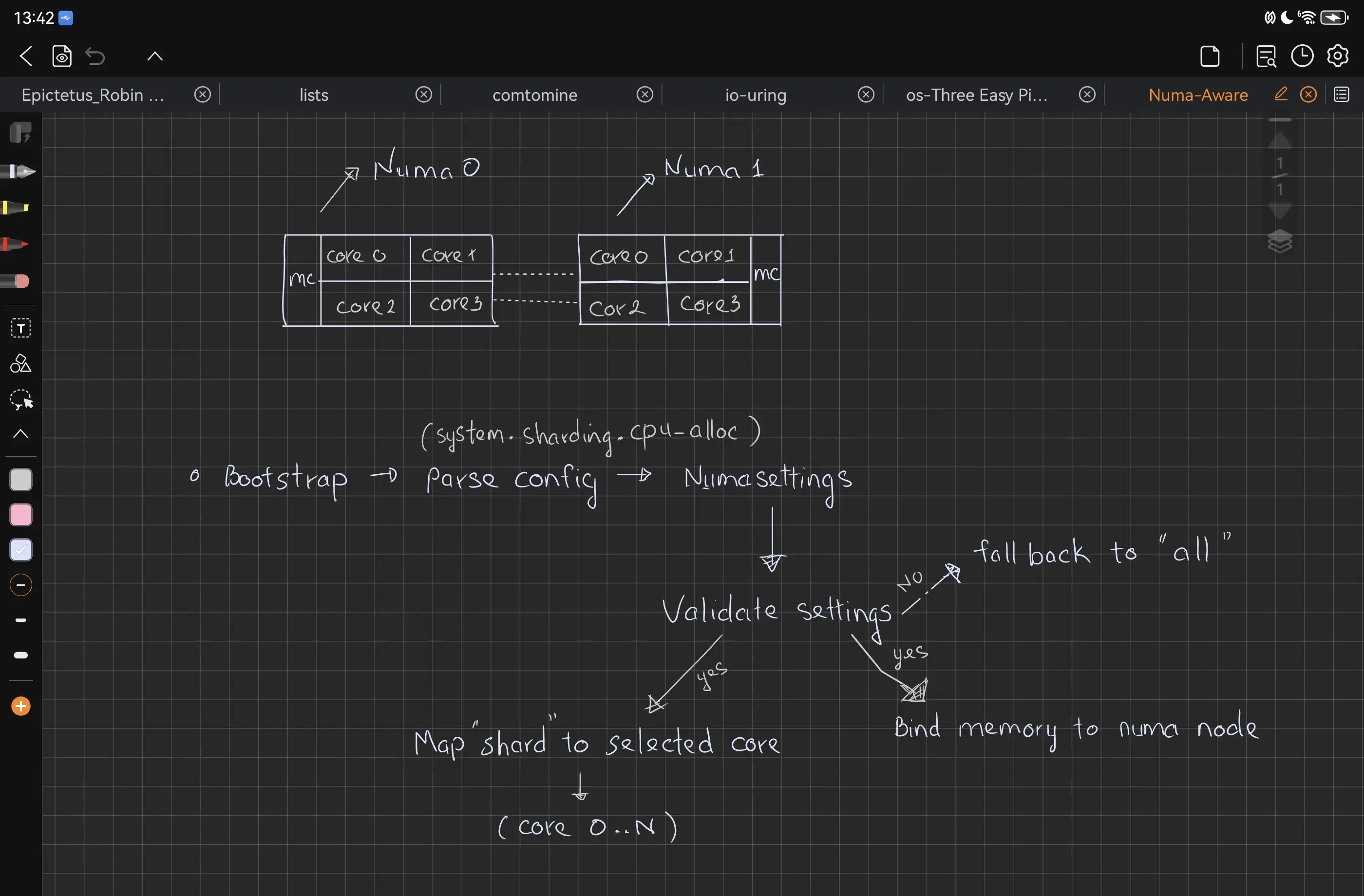
The issue was handled by @tungtose , and the image above was the flow he drew. You can find the original issue #2387 here, filed by @hubcio (Hubert Gruszecki) , and the original pull request here #2412. Merged by @spetz (Piotr Gankiewicz) on Dec 15, 2025.
# line 135
hwlocality = "1.0.0-alpha.11"
// line 50
#[derive(Debug, Clone, PartialEq, Default)]
pub struct NumaConfig {
pub nodes: Vec<usize>,
pub cores_per_node: usize,
pub avoid_hyperthread: bool,
}
// line 178
#[derive(Debug)]
pub struct NumaTopology {
topology: Topology,
node_count: usize,
physical_cores_per_node: Vec<usize>,
logical_cores_per_node: Vec<usize>,
}impl ShardInfo {
pub fn bind_memory(&self) -> Result<(), ServerError> {
if let Some(node_id) = self.numa_node {
let topology = Topology::new().map_err(|err| ServerError::TopologyDetection {
msg: err.to_string(),
})?;
let node = topology
.objects_with_type(ObjectType::NUMANode)
.nth(node_id)
.ok_or(ServerError::InvalidNode {
requested: node_id,
available: topology.objects_with_type(ObjectType::NUMANode).count(),
})?;
if let Some(nodeset) = node.nodeset() {
topology
.bind_memory(
nodeset,
MemoryBindingPolicy::Bind,
MemoryBindingFlags::THREAD | MemoryBindingFlags::STRICT,
)
.map_err(|err| {
tracing::error!("Failed to bind memory {:?}", err);
ServerError::BindingFailed
})?;
info!("Memory bound to NUMA node {node_id}");
}
}
Ok(())
}
}Although I don’t understand it many17, it’s much better than the
indiscriminate thread allocation based on simple CPU sets
from available_parallelism(). And even more delightful is
that as a newcomer, I can finally write code happily.
 Tungtose@tungtose. No description provided.
Wait, Some Compiling Dependencies Missing
It turns out that hwloc-devel was missing, maybe can infer that
the bug has truly been fixed XD.
But something still doesn’t seem right?
thread 'main' (948800) panicked at /home/svecco/.cargo/registry/src/mirrors.tuna.tsinghua.edu.cn-4dc01642fd091eda/hwlocality-sys-0.6.4/build.rs:82:10:
Could not find a suitable version of hwloc:
pkg-config exited with status code 1
> PKG_CONFIG_ALLOW_SYSTEM_LIBS=1 PKG_CONFIG_ALLOW_SYSTEM_CFLAGS=1 pkg-config --static --libs --cflags hwloc 'hwloc >= 2.0.0' 'hwloc < 3.0.0'

The system library `hwloc` required by crate `hwlocality-sys` was not found.
The file `hwloc.pc` needs to be installed and the PKG_CONFIG_PATH environment variable must contain its parent directory.
The PKG_CONFIG_PATH environment variable is not set.

HINT: if you have installed the library, try setting PKG_CONFIG_PATH to the directory containing `hwloc.pc`.

note: run with `RUST_BACKTRACE=1` environment variable to display a backtrace
Of course, we can instantly solve this problem by installing hwloc-devel package via dnf:
Updating and loading repositories:
Repositories loaded.
Package                  Arch    Version                  Repository         Size
Installing:
 hwloc-devel             x86_64  2.12.0-2.fc43            fedora        665.3 KiB
Installing dependencies:
 infiniband-diags        x86_64  58.0-4.fc43              fedora        961.8 KiB
 libibumad               x86_64  58.0-4.fc43              fedora         43.9 KiB
 rdma-core-devel         x86_64  58.0-4.fc43              fedora        613.8 KiB

Transaction Summary:
 Installing:         4 packages

Total size of inbound packages is 1 MiB. Need to download 1 MiB.
After this operation, 2 MiB extra will be used (install 2 MiB, remove 0 B).
Is this ok [y/N]: y
[1/4] infiniband-diags-0:58.0-4.fc43.x86 100% | 611.2 KiB/s | 328.2 KiB |  00m01s
[2/4] hwloc-devel-0:2.12.0-2.fc43.x86_64 100% | 664.9 KiB/s | 361.0 KiB |  00m01s
[3/4] rdma-core-devel-0:58.0-4.fc43.x86_ 100% | 712.8 KiB/s | 429.8 KiB |  00m01s
[4/4] libibumad-0:58.0-4.fc43.x86_64     100% | 372.5 KiB/s |  27.2 KiB |  00m00s
---------------------------------------------------------------------------------
[4/4] Total                              100% |   1.8 MiB/s |   1.1 MiB |  00m01s
Running transaction
[1/6] Verify package files               100% |   1.3 KiB/s |   4.0   B |  00m00s
[2/6] Prepare transaction                100% |  19.0   B/s |   4.0   B |  00m00s
[3/6] Installing libibumad-0:58.0-4.fc43 100% |   2.3 MiB/s |  44.7 KiB |  00m00s
[4/6] Installing infiniband-diags-0:58.0 100% |  56.2 MiB/s | 978.7 KiB |  00m00s
[5/6] Installing rdma-core-devel-0:58.0- 100% |  41.7 MiB/s | 682.7 KiB |  00m00s
[6/6] Installing hwloc-devel-0:2.12.0-2. 100% |   2.7 MiB/s | 747.8 KiB |  00m00s
Complete!
But why does the installation of hwloc still fail when using Nix? Go have some tries.
nixos-version:                  25.11.20251215.c6f52eb (Xantusia)
hwloc-info --version:           hwloc-info 2.12.2rc1-git
.r--r--r-- 439 root 1 Jan 1970 hwloc.pcHmm… that’s really puzzling. But there’s a somewhat hacky way to fix it.
Finished `dev` profile [unoptimized + debuginfo] target(s) in 0.33sLet’s look at the
source code.
Ah, if hwloc.pc is in the dev of the nixpkgs, there will be multiple outputs…
So I can’t rely on installing it correctly by just adding the package name directly.
outputs = [ "out" "lib" "dev" "doc" "man" ];
# "out" was the default output. Below was my installation:
packages = with pkgs; [ hwloc ];
IEC != SI
The picture below shows the textbook for Information Technology in Chinese senior high.

But IT IS WRONG18. The correct one is following IEC 60027-219, which looks like this20.
| Units Computers Use | IEC | Value | Units Hardware Vendors Use | SI | Value |
|---|---|---|---|---|---|
| Kibibyte | KiB | 1024¹ | Kilobyte | kB | 1000¹ |
| Mebibyte | MiB | 1024² | Megabyte | MB | 1000² |
| Gibibyte | GiB | 1024³ | Gigabyte | GB | 1000³ |
| Tebibyte | TiB | 1024⁴ | Terabyte | TB | 1000⁴ |
| Pebibyte | PiB | 1024⁵ | Petabyte | PB | 1000⁵ |
| Exbibyte | EiB | 1024⁶ | Exabyte | EB | 1000⁶ |
| Zebibyte | ZiB | 1024⁷ | Zettabyte | ZB | 1000⁷ |
| Yobibyte | YiB | 1024⁸ | Yottabyte | YB | 1000⁸ |
I didn’t know any of this at first, until started with the Apache Iggy, @Hubcio pointed it out to me.
 assert_eq!( return_bytes(1 GiB) ,        1000000000 );
/* Panicked. Left: 1073741824    , Right: 1000000000 */
Are You Sure
Alright, I’m not sure really. I’ll take a closer look before --force it next time.
If I don’t have enough time, just test it later,
also learn to write your own test scenarios.
Don’t always ask others to test features,
it’s not a good practice, and usually wastes maintainers’ time.
Now, let’s see what silly things this guy @Jysve did.
if let Err(e) = std::fs::create_dir_all(&logs_path) {
    tracing::warn!("Failed to create logs directory {:?}: {}", logs_path, e);
// Check available disk space, at least 10MiB
let min_disk_space: u64 = 10 * 1024 * 1024;let max_files = Self::calculate_max_files(
config.max_size.as_bytes_u64(),
config.max_size.as_bytes_u64(),let path = logs_path.to_path_buf();
let max_size = config.max_size.as_bytes_u64();
let retention = config.retention.get_duration();
let rotation_mutex = Arc::new(Mutex::new(()));fn default_max_total_log_size() -> IggyByteSize { IggyByteSize::from(4_000_000_000) }
fn default_log_rotation_check_interval() -> u64 { 3600 }fn install_log_rotation_handler(&self, config: &LoggingConfig, logs_path: Option<&PathBuf>) { ... }fn cleanup_log_files(logs_path: &PathBuf, retention: Duration, max_size_bytes: u64) {...}match rotation_result {
Ok(()) => println!("Succeeded Verified Log Rotation"),
Err(e) => { eprintln!("Failed: {e}"); }
}I don’t know if staying up late frequently is one of
the reasons for these outrageous problems.
But for now, it just seems like an excuse for not being good enough.
Btw, according to
Programming Rust
, when there are multiple line macro calls, rem comma. 21
reg_set_bits!(
    GPIO_CTRL_REG, /*
    0x01,           *   Typically, it refers to multi lines
    0x04,           *   macro invocations with a variable
    0x10            *   number of arguments.
    0x10,           *   Go Add Trailing Comma.
)?;                 */
Make a Clean Git Log
Judging from the current git log of the
sve.moe site’s refactoring:
5f5d99c arst   | 4b5b2a9 fix(style): err rendered btn and refine horizonal lines
e46e4af qwfp   | 211112c fix(name): officiallly, NixOS CN Meetup -> NixCN Conference
221db94 neio   | 42d9a53 fix(render): remove duplicate blur to reduce graphics load (#12)
eb408c2 ??     | 83d643e fix(archives): which to keep, which ... carry on. (#11)
b81821e xcdv   | 34ca32e feat(sve): some() => render.presure().alleviate(bit) (#10)
4db971b ababa  | 65f1d68 feat(api): impl data cache for github api pulls
8387e24 OvO    | ed70a3e feat(fuwari): many personalizations
1287507 luyj   | 3df9f6f init(fuwari): by svecco on sve.moe
It’s true that NO ONE has required me to use commit messages like this for
my own tiny git repos, but I just can’t help it. It must be because
commit d98176a36a565ec3a47a6a5e52869a2dd6cc36c4
Author: Piotr Gankiewicz <piotr.gankiewicz@gmail.com>
Date:   Thu Feb 5 15:12:00 2026 +0100
"
    fix(server): memory leak in segment rotation (#2686)

    Segment rotation accumulated memory indefinitely because sealed segments
    retained their 16MB index buffers and kept file writers open. Under
    heavy write load with frequent rotations, this caused memory to balloon
    from ~100MB to 20GB+.

    The fix clears index buffers for sealed segments (when cache_indexes !=
    All) and closes their writers immediately after sealing. Writers are
    never needed post-seal, and this also releases io_uring/kernel file
    handle resources.
"
Mysterious Bug
warning: Invalid record ( Producer: 'LLVM21.1.3-rust-1.92.0-stable'
                          Reader  : 'LLVM 21.1.3-rust-1.92.0-stable')

error: failed to load bitcode of module "server-f3f5ee30feef62f6.server.74b6934297a2875c-cgu.0.rcgu.o":

warning: `bdd` (test "basic_messaging") generated 1 warning
error: could not compile `bdd` (test "basic_messaging") due to 1 previous error; 1 warning emitted
warning: build failed, waiting for other jobs to finish...
Is there a difference in the space?
CI/CD Workflow
GitHub Actions
According to the public standards on GitHub, I initially thought ASF’s CI was paid by them22, because the project is large, there are many compilations, and community are very active.
The uniqueness of a toolchain is jointly identified by its version && hash.
Different hashes are regarded as different toolchains.
However, initially, due to system environment issues, the Clippy check could not be run. Since the issue can only be reproduced on NixOS
Clippy source code to replace.
pub fn compare_rustc_versions(
    &self,
    current: &RustcInfo,
    artifact: &RustcInfo
) -> VersionCompatibility {


    if current.commit_hash == artifact.commit_hash && !current.commit_hash.is_empty() {
        return VersionCompatibility::ExactMatch;
    }

    if current.version == artifact.version {
        return VersionCompatibility::VersionMatch;
    }

    let current_parts: Vec<&str> = current.version.split('.').collect();
    let artifact_parts: Vec<&str> = artifact.version.split('.').collect();
    if current_parts.len() >= 2 && artifact_parts.len() >= 2 {
        if current_parts[0] == artifact_parts[0] && current_parts[1] == artifact_parts[1] {
            return VersionCompatibility::MinorVersionMatch;
        }
    }

    VersionCompatibility::Different
}
Detected a version mismatch:
The Rust compiler (rustc) version 1.92.0 (3df9f6f) used during
the build process does not match the rustc 1.92.0 (ed70a3e) used
to build the compiled artifact.
Aborted with 1 error. Clippy check failed.Obviously, I don’t really want to mess with it, just force it first and see. So this happens often:

Then I felt that something didn’t right, so I check the GitHub Actions Manual, and get this:
| Operating system | Billing SKU | Per-minute rate (USD) |
|---|---|---|
| Linux 1-core (x64) | actions_linux_slim | $0.002 |
| Linux 2-core (x64) | actions_linux | $0.006 |
| Linux 2-core (arm64) | actions_linux_arm | $0.005 |
| Windows 2-core (x64) | actions_windows | $0.010 |
| Windows 2-core (arm64) | actions_windows_arm | $0.010 |
| macOS 3-core or 4-core (M1 or Intel) | actions_macos | $0.062 |
Permissions Size User   Date Modified Name
.rw-r--r--@ 9.4k svecco 13 Feb 21:47  _build_python_wheels.yml
.rw-r--r--@  11k svecco 13 Feb 21:47  _build_rust_artifacts.yml
.rw-r--r--@  13k svecco 13 Feb 21:47  _common.yml
.rw-r--r--@  17k svecco 13 Feb 21:47  _detect.yml
.rw-r--r--@ 7.8k svecco 13 Feb 21:47  _publish_rust_crates.yml
.rw-r--r--@ 4.6k svecco 13 Feb 21:47  _test.yml
.rw-r--r--@ 4.2k svecco 13 Feb 21:47  _test_bdd.yml
.rw-r--r--@ 6.6k svecco 13 Feb 21:47  _test_examples.yml
.rw-r--r--@  10k svecco 13 Feb 21:47  post-merge.yml
.rw-r--r--@  17k svecco 13 Feb 21:47  pre-merge.yml
.rw-r--r--@  52k svecco 13 Feb 21:47  publish.yml
.rw-r--r--@ 2.0k svecco 13 Feb 21:47  stale-prs.yml
Oh my, the cost would be quite high when the workload is heavy. Although just 2 synchronized by me, there were many others running, too. Anyway, it would be better to mention it to @spetz. I’ve had a fever for the few days at the beginning of 2026 and haven’t been able to work, better nothing serious happens, or I’ll just have to watch helplessly.

Fortunately. Well, although it’s true23 that Microsoft a sponsor to The ASF, 24 what matters more is this line from @spetz after I asked:
Thank you for all the changes, and dont worry about CI.

Why Not Container?
My local computing power is just sitting idle anyway, so I may as well put it to use.
Local CI/CD
Since a powerful computer cluster can be shared, running CI/CD on the cloud is
generally the recommended choice. As for doing this locally, it seems rather
controversial, as it competes for computing power with subsequent development work.
Act is an open source project that provides a way to run CI/CD locally, written in Golang.
Act uses Docker to run the CI/CD workflow, which is the default,
offering 3 image sizes: micro, medium, and large. In most cases,
medium is sufficient. The large version can fully replicate the
GitHub CI environment, comes pre-installed with all the toolchains
included in the GitHub Actions runner, and can take up nearly 70 GB
after decompression.
IMAGE                             ID             DISK USAGE   CONTENT SIZE   EXTRA
catthehacker/ubuntu:full-latest 9327301aea27 67.2 GB 16.8 GB| GitHub Runner | Micro Docker Image | Medium Docker Image | Large Docker Image |
|---|---|---|---|
ubuntu-latest | node | catthehacker/ubuntu | catthehacker/ubuntu |
ubuntu-22.04 | node | catthehacker/ubuntu.04 | catthehacker/ubuntu.04 |
ubuntu-20.04 | node | catthehacker/ubuntu.04 | catthehacker/ubuntu.04 |
ubuntu-18.04 | node | catthehacker/ubuntu.04 | catthehacker/ubuntu.04 |
Even if some is installed, it may still fail to
run, because GitHub Actions runs on fully virtualized machines,
while act is based on Docker containers. The former is
with the OOM Killer disabled and no seccomp/apparmor
security restrictions, it can be more convenient.25
# ***wget***
wget -qO- https://github.com/nektos/act/releases/download/v0.2.84/act_Linux_x86_64.tar.gz | tar xvz
mv ./act /usr/local/bin/act && act --version        # No need use path to run
# Golang required
git clone https://github.com/nektos/act.git && cd act && go installHowever, pulling the full image directly doesn’t seem to work either.
This is because GitHub maintains its own official images,
while the full version here does not include the Rust toolchain,
which causes failures, can not find the rust toolchain or something.
# For convenience, Docker will be used directly for demonstration below.
doas docker pull catthehacker/ubuntu:rust-latest # Fetch this
doas act -P ubuntu-latest=catthehacker/ubuntu:rust-latest \
            --platform linux/amd64 \
            --container-architecture linux/amd64 \
            --pull=false \
            --defaultbranch=master \
            --container-cap-add SYS_ADMIN \
            --container-cap-add IPC_LOCK \
            --container-options "--security-opt seccomp=unconfined --security-opt apparmor=unconfined -v /dev/shm:/dev/shm --privileged" \
            --verbose
Yay, it compiles! But after a while:
|      Summary [ 111.807s] 1250 tests run: 1233 passed, 17 failed, 96 skipped
|         FAIL [   0.364s] ( 784/1250) integration::mod cli::personal_access_token::
|                                      test_pat_login_options::should_be_successful
|         FAIL [   0.199s] ( 814/1250) integration::mod cli::system::
|                                      test_cli_session_scenario::should_be_successful
|         FAIL [  26.639s] (1129/1250) integration::mod connectors::http_config_provider::
|                                      direct_responses::sink_active_config_returns_
|                                      current_version
|         FAIL [  26.551s] (1130/1250) integration::mod connectors::http_config_provider::
|                                      direct_responses::sink_configs_list_returns_all_
|                                      versions
|         FAIL [  27.207s] (1140/1250) integration::mod connectors::http_config_provider::
|                                      direct_responses::source_active_config_returns_
|                                      current_version
|         FAIL [  27.525s] (1141/1250) integration::mod connectors::http_config_provider::
|                                      direct_responses::sink_config_by_version_returns_
|                                      specific_version
|         FAIL [  28.282s] (1154/1250) integration::mod connectors::http_config_provider::
|                                      wrapped_responses::sink_active_config_returns_
|                                      current_version
|         FAIL [  28.362s] (1156/1250) integration::mod connectors::http_config_provider::
|                                      direct_responses::source_config_by_version_returns_
|                                      specific_version
|         FAIL [   7.141s] (1159/1250) integration::mod server::message_cleanup::
|                                      message_cleanup::expiry_multipartition_expects
|         FAIL [  28.521s] (1163/1250) integration::mod connectors::http_config_provider::
|                                      wrapped_responses::sink_configs_list_returns_all_
|                                      versions
|         FAIL [  28.885s] (1168/1250) integration::mod connectors::http_config_provider::
|                                      direct_responses::source_configs_list_returns_all_
|                                      versions
|         FAIL [  28.930s] (1170/1250) integration::mod connectors::http_config_provider::
|                                      wrapped_responses::sink_config_by_version_returns_
|                                      specific_version
|         FAIL [  28.913s] (1188/1250) integration::mod connectors::http_config_provider::
|                                      wrapped_responses::source_config_by_version_returns
|                                      _specific_version
|         FAIL [  29.320s] (1236/1250) integration::mod connectors::http_config_provider::
|                                      wrapped_responses::source_active_config_returns_
|                                      current_version
|         FAIL [  29.434s] (1237/1250) integration::mod connectors::http_config_provider::
|                                      wrapped_responses::source_configs_list_returns_all_
|                                      versions
|         FAIL [ 106.101s] (1249/1250) integration::mod connectors::quickwit::quickwit_
|                                      sink::given_bulk_message_send_should_store
|         FAIL [ 109.062s] (1250/1250) integration::mod connectors::quickwit::quickwit_
|                                      sink::given_existent_quickwit_index_should_store
| error: test run failed
- target: x86_64-unknown-linux-gnu # As the arch above, linux/amd64
runner: ubuntu-latestJudging from the logs, everything points to one thing:
failed to start test harness: Health check failed for iggy-connectors at http://127.0.0.1:35235 after 1000 retries

failed to start test harness: Health check failed for iggy-connectors at http://127.0.0.1:40443 after 1000 retries
failed to start test harness: Health check failed for iggy-connectors at http://127.0.0.1:39753 after 1000 retries
Received an invalid HTTP response when ingesting messages for index: test_topic. Status code: 404 Not Found, reason: { "message": "index test_topic not found" }

search: InvalidState{message:"Expected 13 documents but got 0 after 100 poll attempts"}
doas (svecco@orion) password:
NETWORK ID NAME DRIVER SCOPE
8462db97170e bridge bridge local
31ea411fde48 host host local
5cefc05182e2 iggy-quickwit-sink-4bd7b25b-36fb-4b04-97f1-ce11755d4322 bridge local
1f577e667a52 none null localdoas docker ps -a | grep iggy-quickwit | awk '{print $1}' | xargs -r doas docker rm -f
doas docker network rm iggy-quickwit-sink-4bd7b25b-36fb-4b04-97f1-ce11755d4322
docker container prune -f && docker network prune -f # Later I did.Uh? DinD? We may need --net=host attribute.
Enables Docker-in-Docker container nesting capability, delivering a clean, isolated solution for containerized CI/CD pipelines, automated image building, environment replication and other container-native workflows, while avoiding dependency conflicts with the host environment.26
quickwit-sink is a core delivery component of the cloud-native containerized logging stack, which streamlines unified log forwarding, indexing and persistence to Quickwit, with out-of-the-box compatibility and lighter configuration overhead for containerized environments.27
You May Have to Edit the Configs Under .github/ to Disable Some Tests
For Features Like CodeCoverage, You May Need a Token for Authentication
When act runs third-party Actions from the GitHub Marketplace (e.g., codecov-action).
codecov-action requires a CODECOV_TOKEN (generated from the Codecov platform) to upload coverage reports.
A GitHub Personal Access Token (PAT) is optionally needed for GitHub API
authentication to reduce the risk of rate limiting, not mandatory for basic functionality.
You can generate a GitHub PAT here: GitHub Personal Access Tokens.
You can pass secrets to act by using: --secret-file <path/to/token/file>, e.g., add CODECOV_TOKEN=xxx or GITHUB_TOKEN=xxx.
────────────
     Summary [ 145.190s] 1454 tests run: 1454 passed (7 slow), 96 skipped
Notice: Tests executed in 161s (02:41)

=========================================
All targets build:             17s (00:17)
Tests compile:                 30s (00:30)
Tests execute:                 161s (02:41)
-----------------------------------------
Total build:                   47s (00:47)
Total time:                    208s (03:28)
=========================================
Others
I’ve been shown!

28Original Text
I’m thrilled to see this PR merged ^_^
This is my first ever Rust PR, and also my first contribution to be merged into a formal project that’s nearing 4k stars, rather than a package repo or other casual repositories. As a student, I initially feared the long dev and review cycle would be a hassle, but I’m extremely grateful to @hubcio and @spetz for your unparalleled patience in guiding and reviewing my work, who have helped me get up to speed with the workflow of a production ready backend project. I’ve also learned many things else e.g.podman, and many exp that I’d never get in school.
Thanks, again :)

(Blog of Iggy Release 0.7.0, February 24, 2026)
References
-
The Apache Software Foundation, Apache Software Foundation Celebrates 25 Years, Mar. 25, 2024. [Accessed: Feb. 13, 2026]. [Online]. ↩
-
The Apache Software Foundation, Valuating Code at The Apache Software Foundation, DinoSource, 2022. [Accessed: Feb. 13, 2026]. [Online]. ↩
-
America’s Cyber Defense Agency, Apache Log4j Vulnerability Guidance, ED 22-02, Apr. 08, 2022. [Accessed: Feb. 13, 2026]. [Online]. ↩
-
The Apache Software Foundation, Apache Log4j, Dec. 9, 2021. [Online]. (Log4Shell, CVE-2021-44228: Remote Code Execution (RCE) vulnerability, CVSSv3 10.0/10.0 severity) ↩
-
CrowdStrike, Remote Code Execution (RCE), [Online]. ↩
-
J. Gardner, Why Java Sucks, Jul. 18, 2017. [Accessed: Feb. 14, 2026]. [Online]. ↩
-
At my worst during this period, I even forgot the name of the PCIe interface. I didn’t know how to use Tmux either. I truly admire some middle school students who can code proficiently and contribute actively to various projects something I couldn’t do as a high school student. It was not until late 2023 to early 2025 that I gradually got back on track with Ubuntu. ↩
-
While I have created multiple commits locally, while the remote branch has updated some of these commits via a
squash merge, I would create a new branch and thencherry-pickthe desired commits one by one … Obviously,rebase --ontois fine. ↩ -
The Iggy Docs, Apache Iggy Documentation, n.d. [Accessed: Feb. 22, 2026]. [Online]. ↩
-
Initially, I aimed to avoid division by zero errors by outright blocking any operation that set the value to zero. Later, I noticed that
IggyByteSizeactually defines a specific meaning for the zero value, so I revised the logic to treat it as “unlimited” to align with the behavior stated in comments throughout the rest of the codebase. ↩ -
A. Kotsiolis, Simultaneous Multithreading: Driving Performance and Efficiency on AMD EPYC CPUs, AMD Official Blog, Mar. 3, 2025. [Accessed: Feb. 14, 2026]. [Online]. ↩
-
Rust Team, The Rust Standard Library (std), Commit 01f6ddf75, Feb. 11, 2026. [Accessed: Feb. 14, 2026]. [Online]. ↩
-
J. L. Hennessy & D. A. Patterson, Computer Architecture: A Quantitative Approach (6th Edition), Elsevier, 2017. [Accessed: Feb. 14, 2026]. [Online]. ↩
-
Wikipedia Contributors, Non-uniform memory access, Wikipedia, The Free Encyclopedia, 2026. [Accessed: Feb. 14, 2026]. [Online]. ↩
-
@linux, What is NUMA, and why do we need to understand NUMA?, Zhihu, Linux Server Development Column, Jul. 14, 2023. [Accessed: Feb. 14, 2026]. [Online]. ↩
-
Crate
hwloc: Rust Bindings for the Hwloc library. Thehwloclibrary is arustbinding to thehwlocC library, which provides a portable abstraction of the hierarchical topology of modern architectures, including NUMA memory nodes, sockets, shared caches, cores and simultaneous multithreading. ↩ -
hwlocality Developers, hwlocality: Rust binding for hwloc, [Online]. (Designed for hardware topology detection, NUMA support, and thread binding optimization; secure, easy to use & actively maintained). [Accessed: Feb. 14, 2026]. ↩
-
CGPM, SI, Conférence Générale des Poids et Measures. [Online]. [Accessed: Feb. 14, 2026]. ↩
-
I.E.C., IEC 60027, International Electrotechnical Commission. [Online]. [Accessed: Feb. 14, 2026]. ↩
-
Wikimedia Foundation, Inc. & I.E.C., Wikipedia, Nov. 2023. [Accessed: Feb. 14, 2026]. ↩
-
J. Blandy & J. Orendorff & L. F. S. Tindall, Programming Rust 2nd Edition: Fast, Safe Systems Development, Sebastopol, CA: O’Reilly Media Inc., 2021. [Accessed: Feb. 14, 2026]. [Online]. ↩
-
GitHub Inc, GitHub Actions billing, Docs, Jan. 13, 2026. [Accessed: Feb. 14, 2026]. [Online]. ↩
-
The Apache Software Foundation, Our Sponsors, Apache Software Foundation Website, 2025. [Accessed: Feb. 14, 2026]. [Online]. (Sponsors, community, projects, and brand information). ↩
-
The Apache Software Foundation, Our Sponsorship Program, Apache Software Foundation Website, 2025. [Accessed: Feb. 14, 2026]. [Online]. (Sponsors, community, projects, and brand information). ↩
-
Act, Runners, Act User Guide, 2026. [Accessed: Feb. 14, 2026]. [Online]. ↩
-
Meta Inc., What is ‘DinD’? Llama 4 Scout, Feb. 14, 2025. [Accessed: Feb. 14, 2025]. ↩
-
Meta Inc., What is quickwit-sink? Llama 4 Scout, Feb. 14, 2025. [Accessed: Feb. 14, 2025]. ↩
-
@Svecco, Code 3858794990 Comments, GitHub, Apache Iggy Pull Request #2452, Feb. 6, 2026. [Accessed: Feb. 6, 2025]. [Online]. ↩

Continue reading
NixCN Conference Shanghai
The article documents my personal experience of participating in a community conference. Therefore, I do not intend to include too much technical content.


The quiet craft of writing on the web
Notes on publishing slowly in a fast medium, and why the open web still rewards patience and care.