Encounter Apache Iggy
Documenting my experience as a student contributing to Apache Iggy, an incubating high‑performance message‑streaming project under the Apache Software Foundation. It covers many obstacles overcoming, alongside pitfalls.
The Apache Software Foundation, a U.S. 501(c)(3) non-profit foundation committed to software for the public good with the “Community over Code” ethos, manages hundreds1 of influential open source projects that underpin core infrastructure in cloud, big data and web industries, based on community and sponsors, boasting an ecosystem valued at over $30 Billion USD .2
By 12, I could write Java3. I knew how to keep servers alive. I could even stand up my own proxy server from scratch while my classmates were still figuring out what a browser was.
And in November 2025, I still couldn’t figure out git rebase --onto4.
That’s the short version of how I ended up at Apache Iggy. The long version starts with Log4j, CVE-2021-44228, CVSS 10.0, the vulnerability that introduced me to the Apache Software Foundation in the worst possible way. I’m sorry to have gotten to know you this way. [5,6,7]
Between 2021 and 2024, I contributed almost nothing to open source. The reasons are embarrassing and straightforward: Minecraft in 2021, Genshin Impact in 2022, Arknights in 2023, and more. Three years I could have spent tinkering with distros and languages, gone to gacha pulls and raid nights.8
So by late 2025, the gap was obvious. Not just in coding, but also in collaboration. I could write code that ran, but I couldn’t write code that passed review. I didn’t know Docker, I didn’t know distributed compilers, and my commit messages looked like keyboard mashing. I needed a project that would fix all of that: small enough that a student could keep up, active enough that someone would actually review my work, and written in a language I was willing to learn properly.
Apache Iggy was the only one that fit.


Ask for Assignment
Pick Up One Issue
The Apache Software Foundation encourages people to contribute. Volunteers who are unsure where to start can take a look at the project’s good first issues. That’s how I began too: I picked the oldest unclaimed issue. The reason was simple. As a Chinese high school student, I had less than 20 hours available per weekend, and my skills were rusty, so I was worried the work would drag on for a long time.
First, you are a contributor, then you are a committer, and finally you are a PMC member or higher. You may notice that there are also PPMC, which is member of Podling Project Management Committee , belongs to Apache Incubator.9
Apache projects are NOT necessarily hosted on GitHub. Many long established Apache projects still use Apache SVN as their primary version control system and Bugzilla for issue tracking, like Apache HTTP Server Project, rather than GitHub’s Issues and Pull Requests mechanism.
Ask the Collaborators
I figured an issue that had been around for a long time probably meant it was important but not urgent for the maintainers, which would alleviate the mess on them from my slow progress.
 Piotr Gankiewicz@spetz. Software Engineer, Iggy Founder, Apache PPMC.

 Hubert Gruszecki@hubcio. Another crab enthusiast, Apache PPMC.
By checking who merged the pull requests, we could easily tell who has write access. I made an attempt sending a request to @hubcio . He agreed promptly. Later, @spetz also joined the code review. @hubcio and @spetz are highly efficient and responsible collaborators. They’re both Members, and PPMCs.

Email communication is also recommended at times, which might be PUBLIC.
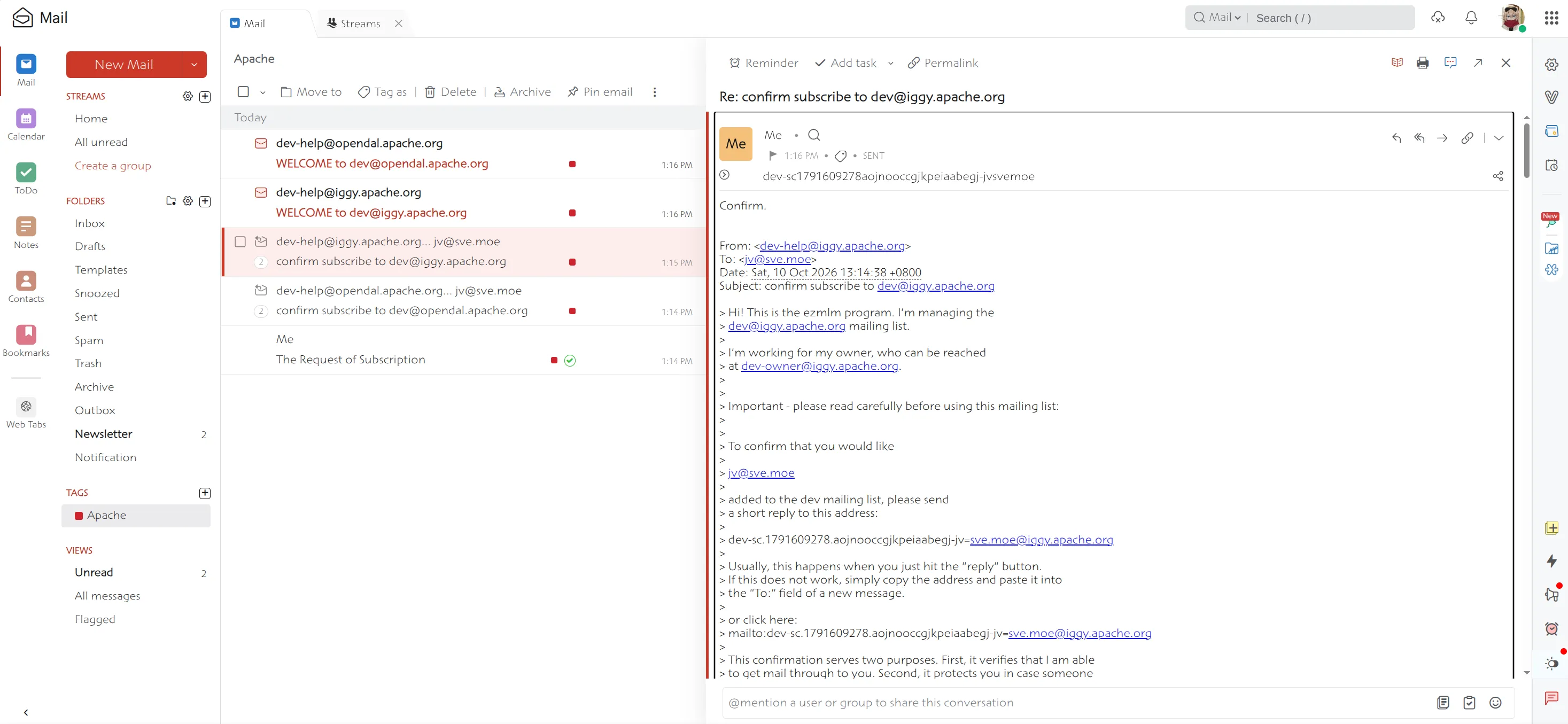
You can receive real-time messages from mailing lists by sending a subscription confirmation.
For instance, sending a blank mail to dev-subscribe@iggy.apache.org and confirm it.
Get On Work
Preparation
Iggy can be deployed with Docker easily:
docker pull apache/iggy:latestdocker run --cap-add=SYS_NICE --security-opt seccomp:unconfined --ulimit memlock=-1:-1 apache/iggy:latestJust like when making contributions normally, first read through
the Code of Conduct,
Contributing Guidelines,
and then make a fork, syncing. Besides, Iggy also provides a cli.
2 collapsed lines
git clone git@github.com:jysve/iggy.gitcd ./iggy/ && ssh-add ~/.ssh/id_ed25519git checkout -b 46-size-logs upstream/mastercargo install iggy-cli && iggy --helpNearly all medium or large modern Rust projects adopt the workspace mechanism.10 I’m not sure why so many Rust learning materials don’t cover it as a key topic, including the Programming Rust, 2nd Edition I have right now.
4 collapsed lines
╭─ $ [svecco] ~/A/iggy git!(46-size-logs)╰─ > cargo clean Removed 65558 files, 52.1GiB total╭─ $ [svecco] ~/A/iggy git!(46-size-logs)╰─ > time sh -c 'cargo build --all-features --all-targets --workspace --release 2>&1 | tail -1' Finished `release` profile [optimized] target(s) in 3m 18s2 collapsed lines
________________________________________________________Executed in 198.65 secs fish external usr time 51.93 mins 407.00 micros 51.93 mins sys time 1.46 mins 61.00 micros 1.46 mins5 collapsed lines
╭─ $ [svecco] ~/A/iggy git!(46-size-logs)╰─ > lscpu | grep "AMD"Vendor ID: AuthenticAMDModel name: AMD Ryzen 9 9950X 16-Core ProcessorVirtualization: AMD-VFrom the project specifications, you can also see how to format your code:
Clippy is a superset of check. Usually, if Clippy passes, you don’t need to run check.11
cargo fmt --all && cargo sort --workspace && cargo machetecargo clippy --all-targets --all-features -- -D warningsbash ./scripts/ci/licenses-list.sh --update --fixbash ./scripts/ci/trailing-whitespace.sh --check --fix# cargo check --all-targets --all-featurescargo run --bin iggy-bench -- -T 50000MB pp -p 5 quic13 collapsed lines
# Or use this:cargo run --release --bin iggy-bench -- \ --message-size 1000 \ --messages-per-batch 10000 \ --message-batches 5000 \ --warmup-time 3s \ --pretty \ balanced-producer \ --streams 1 \ --partitions 24 \ --producers 24 \ tcp \ --server-address 127.0.0.1:8090set -x IGGY_ROOT_USERNAME iggy && set -x IGGY_ROOT_PASSWORD iggy && set -x RUST_LOG debug && cargo run --bin iggy-server -- --with-default-root-credentialsset -x PUBLIC_IGGY_API_URL http://127.0.0.1:3000 && cd web/ && pnpm run dev #If env wasn't set before, please run pnpm/npm (or sth else) install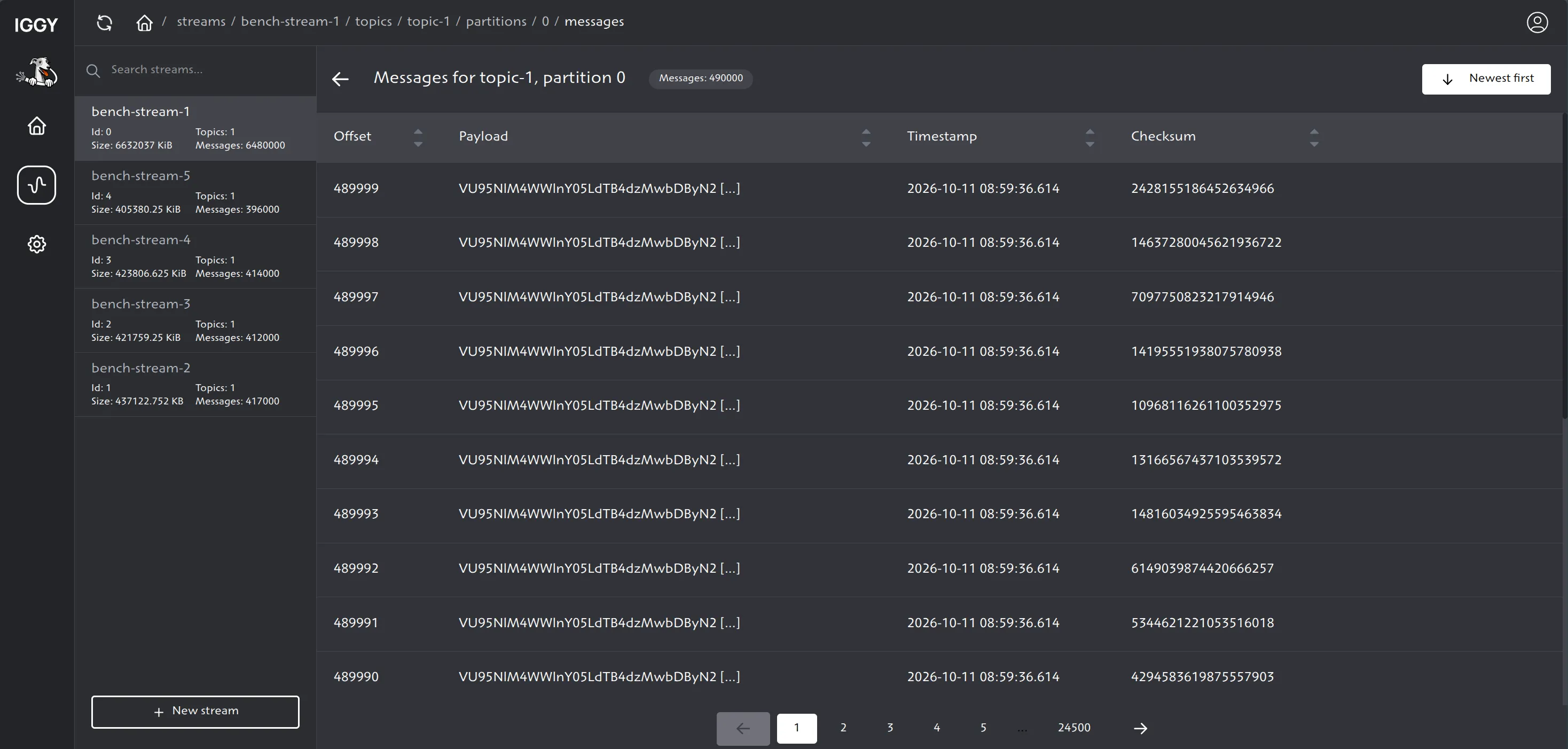
Learn the Structure
Iggy data model, aligned with mainstream message queue, but has own naming convention.12
| Concept | Core Description |
|---|---|
Stream | Top-level namespace isolating business/project message data. |
Topic | Message classification under Stream; maps to message queue; one Stream has many Topics. |
Partition | Parallel unit under Topic; determines concurrency; one Topic has many Partitions. |
Message | Smallest data carrier; contains payload, ID, timestamp, offset, custom headers. |
Consumer | Message consumption endpoint; supports pull by offset, timestamp, batch; auto-commits offsets. |
Iggy’s core business data model and interaction logic. It defines the nested hierarchy from the top-level namespace Stream down to the atomic data unit Message, and standardizes the core send/poll operations between producers and consumers.
Iggy’s layered technical architecture. It maps the complete end-to-end data path from multi-language SDK clients through the transport layer and core processing engine to the persistent storage layer, along with the officially supported transport protocol options.
Iggy’s two core end-to-end workflows: message production and consumption. It details the full lifecycle of a message, covering client authentication, routing and persistent append for production, as well as subscription, batch fetching and offset commit for consumption.
| Path | Work |
|---|---|
| core/server/src/configs | Config management |
| core/server/src/log | Logging management |
And for the issue, for example, server.toml controls the default configuration file, while defaults.rs handles the parsing of default values, and validators.rs is responsible for validating data integrity preventing issues like rotation times approaching zero13, for instance.
In the integration phase, as the name, we perform integration testing,
which fully and independently implements features testing. Relying solely
on unit testing is insufficient for complex projects involving
overall system operation.

Implementing Feats
fn calculate_max_files(max_total_size, max_file_size,) -> usize { ... }fn install_log_rotation_handler(&self, config, logs_path,) -> Option<()> { ... }fn run_log_rotation_loop(path, retention, ... , check_interval, should_stop, rx,) { ... }fn read_log_files(logs_path) -> Vec<(fs::DirEntry, SystemTime, Duration, u64)> { ... }fn cleanup_log_files(logs_path, retention, max_total_size, max_file_size,) { ... }impl Drop for Logging { fn drop(&mut self) { ... } }Logically, the implementation is straightforward, divide max_total_size
by max_file_size to get the upper limit of the quantity, then read
the rotation_check_interval and retention cycles configured by the
user. After that, push file entries to
Vec<(fs::DirEntry, SystemTime, Duration, u64)>, after calculating, for
deletion according to these scheduled timings, and finally remove
a batch.
fn is_valid_iggy_log_file(file_name,) -> bool { ... }async fn run(client_factory, log_dir, present_log_config,) { ... }async fn init_valid_client(client_factory,) -> Result<IggyClient, String> { ... }async fn generate_enough_logs(client,) -> Result<(), String> { ... }async fn validate_log_rotation_rules(log_dir, pre_config,) -> Result<(), String> { ... }async fn nocapture_observer(log_path, title, done,) -> () { ... }# Maximum size of a single log file before rotation occurs. When a log4 collapsed lines
# file reaches this size, it will be rotated (closed and a new file# created). This setting works together with max_total_size to control# log storage. You can set it to 0 to enable unlimited size of single# log, but all logs will be written to a single file, thus disabling# log rotation. Please configure 0 with caution, esp. RUST_LOG > debugmax_file_size = "500 MB"
# Maximum size of the log files before rotation.max_size = "512 MB"5 collapsed lines
# Maximum total size of all log files. When this size is reached,# the oldest log files will be deleted first. Set it to 0 to allow# an unlimited number of archived logs. This does not disable time# based log rotation or per-log-file size limits.max_total_size = "4 GB"3 collapsed lines
# Time interval for checking log rotation status. Avoid less than 1s.rotation_check_interval = "1 h"3 collapsed lines
# Time to retain log files before deletion. Avoid less than 1s, too.retention = "7 days"The above are configuration level changes, and you can also see what
has been implemented from here. Of course, for more specific details,
you may as well directly use the commit hash to check the git log
to find out about
other additions and deletions.
Since the issues people
encounter are diverse, and log rotation is not highly technical,
going into detail here would sacrifice general applicability. So,
I won’t elaborate on the general implementation details here,
instead, I will choose to pick things that I find quite interesting up later.
git show 873b63965998e07ed7b50994286d1397b6359dd5 --stat╭─ $ [svecco] ~/A/iggy git!(master M1 U2)╰─ > git show 873b63965998e07ed7b50994286d1397b6359dd5 --stat27 collapsed lines
commit 873b63965998e07ed7b50994286d1397b6359dd5Author: Svecco <chenrui@sve.moe>Date: Mon Feb 2 17:43:48 2026 +0800
feat(server): implement log rotation based on size and retention (#2452)
- implemented log rotation based on size and retention as the title; - implemented configurable attributes and imported breaking changes; - added units and integration test in logger.rs and integration mod; - added documentations and imported new dependencies, etc.
Cargo.lock | 21 ++++ DEPENDENCIES.md | 2 + core/common/src/utils/byte_size.rs | 7 ++ core/common/src/utils/duration.rs | 29 ++++ core/integration/src/test_server.rs | 4 +- core/integration/tests/server/scenarios/log_rotation_scenario.rs | 382 ++++ core/integration/tests/server/scenarios/mod.rs | 1 + core/integration/tests/server/specific.rs | 5 +- core/server/Cargo.toml | 2 + core/server/config.toml | 22 +++- core/server/src/configs/defaults.rs | 9 +- core/server/src/configs/displays.rs | 8 +- core/server/src/configs/system.rs | 7 +- core/server/src/configs/validators.rs | 47 +++- core/server/src/log/logger.rs | 475 +++- foreign/cpp/tests/e2e/server.toml | 26 +++- 16 files changed, 1009 insertions(+), 38 deletions(-)Panicked OOM Code 12 with 44GiB RAM Empty?!
git reset --hard ff6695ba589656acef68da534b4af55dda452c80 && cargo build --package serverCPU_ALLOCATION="<more than your PHYSICAL cores>" RUST_BACKTRACE=1 cargo run --bin serverThat’s because the process attempted to read an incompatible system metadata file under
the ./local_data/ directory. Just remove the ./local_data/ directory and try again.
On my device (Ryzen 9 9950X, 16 physical / 32 logical with SMT),
cpu_allocation = "19" was the largest value that still started.
What matters is going past the physical core count: "all" maps to
all 32 logical cores, so reproducing this requires
SMT
enabled.14
Generally speaking, this happens when the requested allocation is too
large: mmap/malloc fails with ENOMEM (code 12), the unwrap() in
the shard code panics, and the panic escalates to a server shutdown.15
The kernel isn’t killing the process, the failed allocation simply
propagates up. However, if you check out, and, find there may
something incorrect, but you don’t know exactly what it is:
unlimited, unlimited, 0That’s very strange for me. There are no external restrictions, on the contrary, resources are sufficient, yet it still fails to start, So this is an internal server issue?
2026-02-13T10:08:28.268923Z ERROR main iggy_server: Server shutting down due to shard failure. (shutdown took 31 ms)Error: ShardFailure { message: "Shard 22 panicked: called `Result::unwrap()` on an `Err` value: Os { code: 12, kind: OutOfMemory, message: \"Cannot allocate memory\" }" } total used free shared buff/cache availableMem: 46 Gi 20 Gi 772 Mi 199 Mi 24 Gi 26 GiSince the error is occurring with the shard, let’s look into
the code that implements the shard functionality.
Let’s check how the shard allocated.
impl CpuAllocation { pub fn to_shard_set(&self) -> HashSet<usize> { match self { CpuAllocation::All => { let available_cpus = available_parallelism() .expect("Failed to get num of cores") .get();
(0..available_cpus).collect() } CpuAllocation::Count(count) => (0..*count).collect(), CpuAllocation::Range(start, end) => (*start..*end).collect(), } }}This code that executes kernel allocation seems harmless enough at first
glance, yet there appears to be something off about it. The cores
are allocated via available_parallelism(), man it, see what can we get
from the documentations.
Limitations 16 /
pub fn available_parallelism() -> Result<NonZero<usize>>The purpose of this API is to provide an easy and portable way to query the default amount of parallelism the program should use. Among other things it does not expose information on NUMA regions, does not account for differences in (co)processor capabilities or current system load, and will not modify the program’s global state in order to more accurately query the amount of available parallelism.
“NUMA regions”? What is “NUMA”?
In early computer systems, all CPUs reached memory through a single shared bus and one memory controller, an architecture known as UMA17 (Uniform Memory Access). All CPUs were equal, with no master/slave relationship, so these systems are also “symmetric” (SMP); the term NUMA, by contrast, describes the memory-access model, not processor symmetry. As processor count grew, the shared bus became the critical bottleneck, adding latency between processors and memory.
In the NUMA (Non-Uniform Memory Access) architecture, all cores share one physical address space, but access to different memory regions has different latency: memory attached to the local node is fastest, remote-node memory is slower.18 Each NUMA node has its own memory controller, and cores on different nodes communicate over the processor interconnect (Intel UPI / AMD Infinity Fabric) rather than a single shared system bus as in classic SMP. But on single-socket systems this effect is often minor.19

The speed at which a CPU accesses memory from different node
types varies: access to the local node is the fastest,
while access to remote nodes is the slowest. In other words,
memory access speed depends on the distance to the node, the
greater the distance, the slower the access. This is why it
is called NUMA. The memory
access distance is referred to as Node Distance.
This architecture effectively solves the performance issues
caused by large scale CPU expansion under the UMA (single-bus) model.20
This means: This piece of code directly maps abstract CPU allocation
rules to a set of logical CPU core IDs, where cpu_allocation = "all"
generates a set with a size equal to the number of logical cores
reported by the system. In this scenario, 32 shards are created
instead of 16, which triggers two cascading issues: first,
multiple shards are bound to the SMT threads of the same physical
core, resulting in resource contention. Second, the 32 shards,
combined with the pre-allocated memory pool, generate a massive
amount of instantaneous memory requests.
This exceeds what the kernel’s heuristic overcommit accounting
vm.overcommit_memory=0 is willing to grant, so the pre-allocation
fails with ENOMEM and the shard panics.21 Heuristic mode rejects
allocations it deems obviously larger than (RAM + swap) rather than
enforcing a hard limit, triggering
Code 12 OOM Panic
and causing shard crashes.22
Now, we can examine the source code to see why the documentation states this.
pub fn available_parallelism() -> io::Result<NonZero<usize>> {4 collapsed lines
cfg_select! { any(target_os = "linux") => { #[cfg(any(target_os = "android", target_os = "linux"))] { quota = cgroups::quota().max(1);
let mut set: libc::cpu_set_t = unsafe { mem::zeroed() }; unsafe {11 collapsed lines
if libc::sched_getaffinity(0, size_of::<libc::cpu_set_t>(), &mut set) == 0 {
let count = libc::CPU_COUNT(&set) as usize; let count = count.min(quota);
if let Some(count) = NonZero::new(count) { return Ok(count) } } } }
match unsafe { libc::sysconf(libc::_SC_NPROCESSORS_ONLN) } {4 collapsed lines
-1 => Err(io::Error::last_os_error()), 0 => Err(io::Error::UNKNOWN_THREAD_COUNT), cpus => { let count = cpus as usize; let count = count.min(quota);
Ok(unsafe { NonZero::new_unchecked(count) })4 collapsed lines
} } } }}Over? Nope, still a little. I found this option in the configuration:
# Size of the memory pool (string).# Example: "512 MiB" or "1 GiB".# This defines the maximum, total memory allocated for the memory pool.# Note: This number has to be multiplication of 4096 (default linux page size).# Minimum size is 512 MiB due to internal implementation details.
size = "4 GiB"Reducing the memory pool size (e.g., from 4 GiB to 1 GiB) lowers the initial
pre-allocation peak and decreases the total instantaneous memory demand.
This value may fall within the kernel’s “repayable” memory range, allowing
the server to start occasionally. Under overcommit_memory=0, ENOMEM is about the size of the
mapping the heuristic sees, not how much RAM is free - 46 GiB can sit
unused while a single multi-GiB pre-allocation is still rejected. This
is also why shrinking the memory pool helps: it drops each mapping
below the heuristic’s rejection threshold.
However, this only alleviates the symptoms and does not address the root cause.
Physical cores and SMT threads are not distinguished, nor is there a limit
on the maximum number of shard. Ultimately, this amplifies memory pressure
to the point of triggering an OOM error on SMT enabled multi cores CPU.
Of course, I didn’t know any of this at the beginning of the pull request, nor did I realize it was a NUMA issue. I was fixated entirely on the memory side and was just about to file an issue. After fetching, the problem was suddenly resolved. With some locates, let’s take a look at the commit that fixed the issue.
git show a5d569450ee34441be997786046c7a30785e11f2 --stat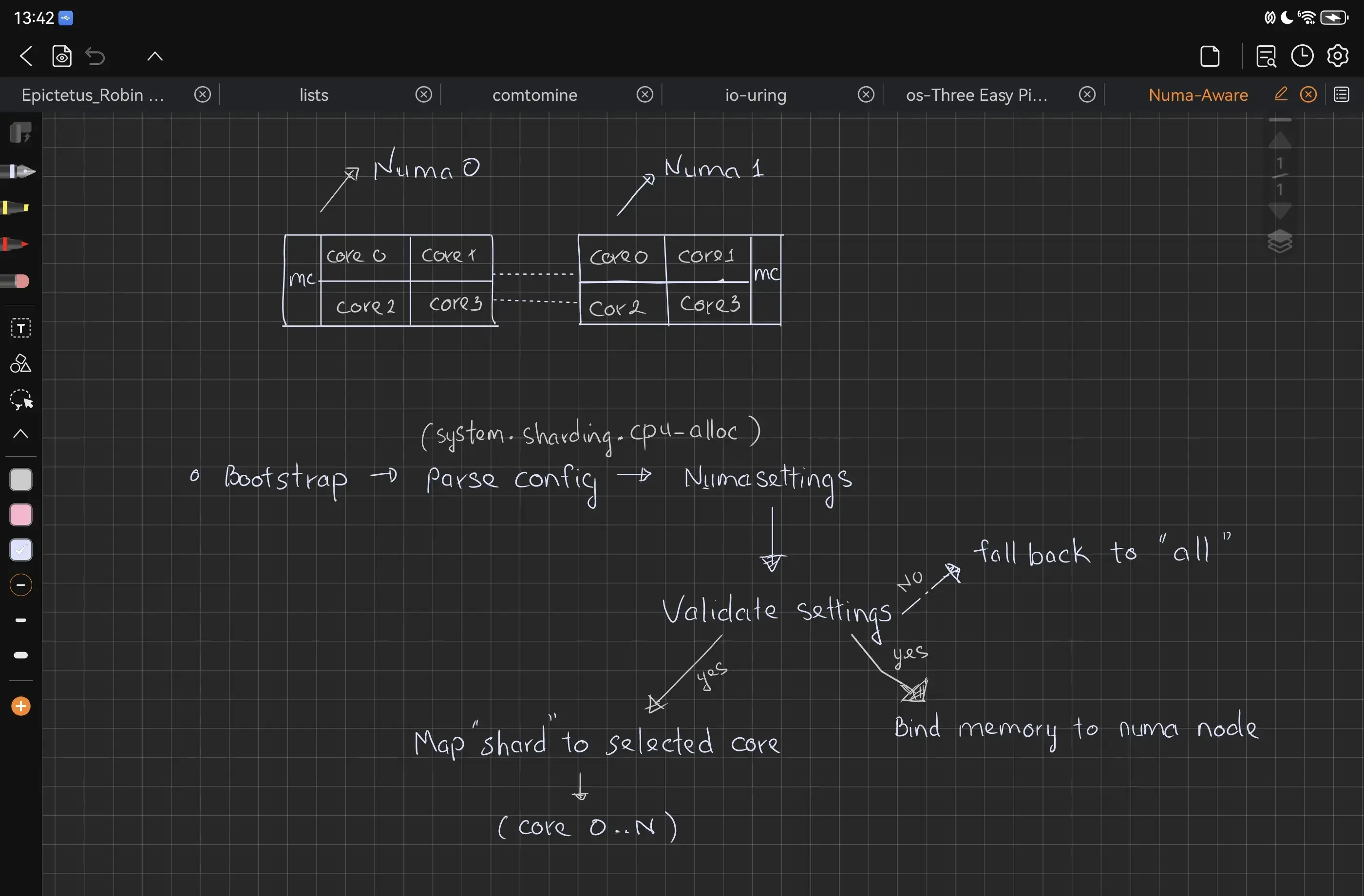
The issue was handled by @tungtose , and the image above was the flow he drew. You can find the original issue #2387 here, filed by @hubcio (Hubert Gruszecki) , and the original pull request here #2412. Merged by @spetz (Piotr Gankiewicz) on Dec 15, 2025.
# line 135hwlocality = "1.0.0-alpha.11"// line 50#[derive(Debug, Clone, PartialEq, Default)]pub struct NumaConfig {3 collapsed lines
pub nodes: Vec<usize>, pub cores_per_node: usize, pub avoid_hyperthread: bool,}
// line 178#[derive(Debug)]pub struct NumaTopology {4 collapsed lines
topology: Topology, node_count: usize, physical_cores_per_node: Vec<usize>, logical_cores_per_node: Vec<usize>,}impl ShardInfo { pub fn bind_memory(&self) -> Result<(), ServerError> {
if let Some(node_id) = self.numa_node { let topology = Topology::new().map_err(|err| ServerError::TopologyDetection {3 collapsed lines
msg: err.to_string(), })?;
let node = topology .objects_with_type(ObjectType::NUMANode) .nth(node_id)5 collapsed lines
.ok_or(ServerError::InvalidNode { requested: node_id, available: topology.objects_with_type(ObjectType::NUMANode).count(), })?;
if let Some(nodeset) = node.nodeset() {
topology .bind_memory(15 collapsed lines
nodeset, MemoryBindingPolicy::Bind, MemoryBindingFlags::THREAD | MemoryBindingFlags::STRICT, ) .map_err(|err| { tracing::error!("Failed to bind memory {:?}", err); ServerError::BindingFailed })?;
info!("Memory bound to NUMA node {node_id}"); } }
Ok(()) }}Although I don’t understand it many23, it’s much better than the
indiscriminate thread allocation based on simple CPU sets
from available_parallelism(). And even more delightful is
that as a newcomer, I can finally write code happily.
 Tung To@tungtose. Pin<Box<dyn Overthinking>>
Wait, Some Compiling Dependencies Missing
It turns out that hwloc-devel was missing, maybe can infer that
the bug has truly been fixed XD.
But something still doesn’t seem right?
4 collapsed lines
thread 'main' (948800) panicked at /home/jysve/.cargo/registry/src/mirrors.tuna.tsinghua.edu.cn-4dc01642fd091eda/hwlocality-sys-0.6.4/build.rs:82:10:Could not find a suitable version of hwloc:pkg-config exited with status code 1> PKG_CONFIG_ALLOW_SYSTEM_LIBS=1 PKG_CONFIG_ALLOW_SYSTEM_CFLAGS=1 pkg-config --static --libs --cflags hwloc 'hwloc >= 2.0.0' 'hwloc < 3.0.0'
The system library `hwloc` required by crate `hwlocality-sys` was not found.The file `hwloc.pc` needs to be installed and the PKG_CONFIG_PATH environment variable must contain its parent directory.5 collapsed lines
The PKG_CONFIG_PATH environment variable is not set.
HINT: if you have installed the library, try setting PKG_CONFIG_PATH to the directory containing `hwloc.pc`.
note: run with `RUST_BACKTRACE=1` environment variable to display a backtraceOf course, we can instantly solve this problem by installing hwloc-devel package via dnf:
3 collapsed lines
Updating and loading repositories:Repositories loaded.Package Arch Version Repository SizeInstalling: hwloc-devel x86_64 2.12.0-2.fc43 fedora 665.3 KiB22 collapsed lines
Installing dependencies: infiniband-diags x86_64 58.0-4.fc43 fedora 961.8 KiB libibumad x86_64 58.0-4.fc43 fedora 43.9 KiB rdma-core-devel x86_64 58.0-4.fc43 fedora 613.8 KiB
Transaction Summary: Installing: 4 packages
Total size of inbound packages is 1 MiB. Need to download 1 MiB.After this operation, 2 MiB extra will be used (install 2 MiB, remove 0 B).Is this ok [y/N]: y[1/4] infiniband-diags-0:58.0-4.fc43.x86 100% | 611.2 KiB/s | 328.2 KiB | 00m01s[2/4] hwloc-devel-0:2.12.0-2.fc43.x86_64 100% | 664.9 KiB/s | 361.0 KiB | 00m01s[3/4] rdma-core-devel-0:58.0-4.fc43.x86_ 100% | 712.8 KiB/s | 429.8 KiB | 00m01s[4/4] libibumad-0:58.0-4.fc43.x86_64 100% | 372.5 KiB/s | 27.2 KiB | 00m00s---------------------------------------------------------------------------------[4/4] Total 100% | 1.8 MiB/s | 1.1 MiB | 00m01sRunning transaction[1/6] Verify package files 100% | 1.3 KiB/s | 4.0 B | 00m00s[2/6] Prepare transaction 100% | 19.0 B/s | 4.0 B | 00m00s[3/6] Installing libibumad-0:58.0-4.fc43 100% | 2.3 MiB/s | 44.7 KiB | 00m00s[4/6] Installing infiniband-diags-0:58.0 100% | 56.2 MiB/s | 978.7 KiB | 00m00s[5/6] Installing rdma-core-devel-0:58.0- 100% | 41.7 MiB/s | 682.7 KiB | 00m00s[6/6] Installing hwloc-devel-0:2.12.0-2. 100% | 2.7 MiB/s | 747.8 KiB | 00m00sComplete!But why does the installation of hwloc still fail when using Nix? Go have some tries.
nixos-version: 25.11.20251215.c6f52eb (Xantusia)hwloc-info --version: hwloc-info 2.12.2rc1-git.r--r--r-- 439 root 1 Jan 1970 hwloc.pcHmm… that’s really puzzling. But there’s a somewhat hacky way to fix it.
Finished `dev` profile [unoptimized + debuginfo] target(s) in 0.33sLet’s look at the
source code.
Ah, if hwloc.pc is in the dev of the nixpkgs, there will be multiple outputs…
So I can’t rely on installing it correctly by just adding the package name directly.24
outputs = [ "out" "lib" "dev" "doc" "man" ];# "out" was the default output. Below was my installation:packages = with pkgs; [ hwloc ];IEC != SI

The picture above shows the textbook for Information Technology in Chinese senior high. But it’s improper sometimes. The better one is following IEC 60027-2, which looks like the table below. I didn’t know any of this at first, until started with the Apache Iggy, @Hubcio pointed it out to me.[25,26,27]
| Units Computers Use | IEC | Value | Units Hardware Vendors Use | SI | Value |
|---|---|---|---|---|---|
| Kibibyte | KiB | 1024¹ | Kilobyte | kB | 1000¹ |
| Mebibyte | MiB | 1024² | Megabyte | MB | 1000² |
| Gibibyte | GiB | 1024³ | Gigabyte | GB | 1000³ |
| Tebibyte | TiB | 1024⁴ | Terabyte | TB | 1000⁴ |
| Pebibyte | PiB | 1024⁵ | Petabyte | PB | 1000⁵ |
| Exbibyte | EiB | 1024⁶ | Exabyte | EB | 1000⁶ |
| Zebibyte | ZiB | 1024⁷ | Zettabyte | ZB | 1000⁷ |
| Yobibyte | YiB | 1024⁸ | Yottabyte | YB | 1000⁸ |
assert_eq!( return_bytes(1 GiB) , 1000000000 );/* Panicked. Left: 1073741824 , Right: 1000000000 */Are You Sure
Alright, I’m not sure really. I’ll take a closer look before --force it next time.
If I don’t have enough time, just test it later,
also learn to write your own test scenarios.
Don’t always ask others to test features,
it’s not a good practice, and usually wastes maintainers’ time.
Now, let’s see what silly things this guy @Jysve did.
if let Err(e) = std::fs::create_dir_all(&logs_path) { tracing::warn!("Failed to create logs directory {:?}: {}", logs_path, e);// Check available disk space, at least 10MiBlet min_disk_space: u64 = 10 * 1024 * 1024;let max_files = Self::calculate_max_files( config.max_size.as_bytes_u64(), config.max_size.as_bytes_u64(),let path = logs_path.to_path_buf();let max_size = config.max_size.as_bytes_u64();let retention = config.retention.get_duration();let rotation_mutex = Arc::new(Mutex::new(()));fn default_max_total_log_size() -> IggyByteSize { IggyByteSize::from(4_000_000_000) }fn default_log_rotation_check_interval() -> u64 { 3600 }fn install_log_rotation_handler(&self, config: &LoggingConfig, logs_path: Option<&PathBuf>) { ... }fn cleanup_log_files(logs_path: &PathBuf, retention: Duration, max_size_bytes: u64) {...}match rotation_result { Ok(()) => println!("Succeeded Verified Log Rotation"), Err(e) => { eprintln!("Failed: {e}"); }}Maybe the sleepless nights are part of the problem, but
honestly, it’s just an excuse for falling short, looking back from now.
Btw, according to
Programming Rust
, when there are multiple line macro calls, rem comma. 28
reg_set_bits!( GPIO_CTRL_REG, /* 0x01, * Typically, it refers to multi lines 0x04, * macro invocations with a variable 0x10 * number of arguments. 0x10, * Go Add Trailing Comma.)?; */Make a Clean Git Log
Judging from the current git log of the
sve.moe site’s refactoring:
5f5d99c arst | 4b5b2a9 fix(style): refine horizonal linese46e4af qwfp | 211112c fix(name): officiallly renamed as NixCN Conference221db94 neio | 42d9a53 fix(render): remove render to reduce graphics loadeb408c2 ?? | 83d643e fix(archives): which to keep, which ... carry on.b81821e xcdv | 34ca32e feat(sve): render.presure().alleviate(bit)4db971b ababa | 65f1d68 feat(api): impl data cache for github api pulls8387e24 OvO | ed70a3e feat(fuwari): many personalizations1287507 luyj | 3df9f6f init(fuwari): by jysve on sve.moeIt’s true that NO ONE has required me to use commit messages like this for
my own tiny git repos, but I just can’t help it. It must be because
been domesticated by Apache.29
commit d98176a36a565ec3a47a6a5e52869a2dd6cc36c4Author: Piotr Gankiewicz <piotr.gankiewicz@gmail.com>Date: Thu Feb 5 15:12:00 2026 +0100" fix(server): memory leak in segment rotation (#2686)
Segment rotation accumulated memory indefinitely because sealed segments7 collapsed lines
retained their 16MB index buffers and kept file writers open. Under heavy write load with frequent rotations, this caused memory to balloon from ~100MB to 20GB+.
The fix clears index buffers for sealed segments (when cache_indexes != All) and closes their writers immediately after sealing. Writers are never needed post-seal, and this also releases io_uring/kernel file handle resources."Mysterious Bug
warning: Invalid record ( Producer: 'LLVM21.1.3-rust-1.92.0-stable' Reader : 'LLVM 21.1.3-rust-1.92.0-stable')5 collapsed lines
error: failed to load bitcode of module "server-f3f5ee30feef62f6.server.74b6934297a2875c-cgu.0.rcgu.o":
warning: `bdd` (test "basic_messaging") generated 1 warningerror: could not compile `bdd` (test "basic_messaging") due to 1 previous error; 1 warning emittedwarning: build failed, waiting for other jobs to finish...Is there a difference in the space?
CI/CD Workflow
GitHub Actions
According to the public standards on GitHub, I initially thought ASF’s CI was paid by them30, because the project is large, there are many compilations, and community are very active.
The uniqueness of a toolchain is jointly identified by its version && hash.
Different hashes are regarded as different toolchains.
However, initially, due to system environment issues, the Clippy check could not be run.
Since the issue can only be reproduced on NixOS … … and cannot be reproduced on Fedora or Gentoo
right now, let’s use the Clippy source code to replace.
pub fn compare_rustc_versions( &self, current: &RustcInfo, artifact: &RustcInfo) -> VersionCompatibility {
if current.commit_hash == artifact.commit_hash && !current.commit_hash.is_empty() { return VersionCompatibility::ExactMatch; }14 collapsed lines
if current.version == artifact.version { return VersionCompatibility::VersionMatch; }
let current_parts: Vec<&str> = current.version.split('.').collect(); let artifact_parts: Vec<&str> = artifact.version.split('.').collect(); if current_parts.len() >= 2 && artifact_parts.len() >= 2 { if current_parts[0] == artifact_parts[0] && current_parts[1] == artifact_parts[1] { return VersionCompatibility::MinorVersionMatch; } }
VersionCompatibility::Different}Detected a version mismatch: The Rust compiler (rustc) version 1.92.0 (3df9f6f) used during the build process does not match the rustc 1.92.0 (ed70a3e) used to build the compiled artifact.
Aborted with 1 error. Clippy check failed.Obviously, I don’t really want to mess with it, just force it first and see. So this happens often:

Permissions Size User Date Modified Name.rw-r--r--@ 9.4k jysve 13 Feb 21:47 _build_python_wheels.yml10 collapsed lines
.rw-r--r--@ 11k jysve 13 Feb 21:47 _build_rust_artifacts.yml.rw-r--r--@ 13k jysve 13 Feb 21:47 _common.yml.rw-r--r--@ 17k jysve 13 Feb 21:47 _detect.yml.rw-r--r--@ 7.8k jysve 13 Feb 21:47 _publish_rust_crates.yml.rw-r--r--@ 4.6k jysve 13 Feb 21:47 _test.yml.rw-r--r--@ 4.2k jysve 13 Feb 21:47 _test_bdd.yml.rw-r--r--@ 6.6k jysve 13 Feb 21:47 _test_examples.yml.rw-r--r--@ 10k jysve 13 Feb 21:47 post-merge.yml.rw-r--r--@ 17k jysve 13 Feb 21:47 pre-merge.yml.rw-r--r--@ 52k jysve 13 Feb 21:47 publish.yml.rw-r--r--@ 2.0k jysve 13 Feb 21:47 stale-prs.ymlOh my, the cost would be quite high when the workload is heavy. Although just 2 synchronized by me, there were many others running, too. Anyway, it would be better to mention it to @spetz. I’ve had a fever for the few days at the beginning of 2026 and haven’t been able to work, better nothing serious happens, or I’ll just have to watch helplessly.

Fortunately. Well, although it’s true31 that Microsoft a sponsor to The ASF, 32 what matters more is this line from @spetz after I asked:
Thank you for all the changes, and dont worry about CI.

I later asked an SRE of Tesla, learning this:
P: ” … … But it doesn’t hold up under scrutiny, because the complexity is merely shifted elsewhere, and the overhead could even be higher.”
What’s the point? Just to save a bit of runner resources? It doesn’t make much sense.
With runner matrices, a single change has to run tests across various architectures, so the volume is already huge. Runners are relatively cheap, though of course, it’s always good to reduce resource usage reasonably.
Q: “Surprisingly, no one has tried batching them. Like the pooled PCR tests, group them into batches of 10, and then subdivide further if any issues are detected. For example, why don’t prioritize running the ones without merge request conflicts first?”
The whole reason we run tests is to catch things we might have overlooked. If you already knew exactly where the issues were, you’d just fix them directly-there’d be no point in not running the full test suite.
Sometimes you even need smoke tests because you never know if a change in one system will impact upstream or downstream dependencies. Even with AI, you can’t avoid this risk, so you still have to run the full tests.
 JCSRE, Full Stack Developer

Then I felt that something didn’t right, so I check the manual, getting this:
| Operating system | Billing SKU | Per-minute rate (USD) |
|---|---|---|
| Linux 1-core (x64) | actions_linux_slim | $0.002 |
| Linux 2-core (x64) | actions_linux | $0.006 |
| Linux 2-core (arm64) | actions_linux_arm | $0.005 |
| Windows 2-core (x64) | actions_windows | $0.010 |
| Windows 2-core (arm64) | actions_windows_arm | $0.010 |
| macOS 3-core or 4-core (M1 or Intel) | actions_macos | $0.062 |
Why Not Container?
My local computing power is just sitting idle anyway, so I may as well put it to use.
Since a powerful computer cluster can be shared, running CI/CD on the cloud is
generally the recommended choice. As for doing this locally, it seems rather
controversial, as it competes for computing power with subsequent development work.
Act is an open source project that provides a way to run CI/CD locally, written in Golang.
Act uses Docker to run the CI/CD workflow, which is the default,
offering 3 image sizes: micro, medium, and large. In most cases,
medium is sufficient. The large version can fully replicate the
GitHub CI environment, comes pre-installed with all the toolchains
included in the GitHub Actions runner, and can take up nearly 70 GB
after decompression.
IMAGE ID DISK USAGE CONTENT SIZE EXTRAcatthehacker/ubuntu:full-latest 9327301aea27 67.2 GB 16.8 GB| GitHub Runner | Micro Docker Image | Medium Docker Image | Large Docker Image |
|---|---|---|---|
ubuntu-latest | node | catthehacker/ubuntu | catthehacker/ubuntu |
ubuntu-22.04 | node | catthehacker/ubuntu.04 | catthehacker/ubuntu.04 |
ubuntu-20.04 | node | catthehacker/ubuntu.04 | catthehacker/ubuntu.04 |
ubuntu-18.04 | node | catthehacker/ubuntu.04 | catthehacker/ubuntu.04 |
Even if some is installed, it may still fail to
run, because GitHub Actions runs on fully virtualized machines,
while act is based on Docker containers. The former is
with the OOM Killer disabled and no seccomp/apparmor
security restrictions, it can be more convenient.33
# ***wget***wget -qO- https://github.com/nektos/act/releases/download/v0.2.84/act_Linux_x86_64.tar.gz | tar xvzmv ./act /usr/local/bin/act && act --version # No need use path to run# Golang requiredgit clone https://github.com/nektos/act.git && cd act && go installHowever, pulling the full image directly doesn’t seem to work either.
This is because GitHub maintains its own official images,
while the full version here does not include the Rust toolchain,
which causes failures, can not find the rust toolchain or something.
# For convenience, Docker will be used directly for demonstration below.doas docker pull catthehacker/ubuntu:rust-latest # Fetch thisdoas act -P ubuntu-latest=catthehacker/ubuntu:rust-latest \ --platform linux/amd64 \ --container-architecture linux/amd64 \ --pull=false \ --defaultbranch=master \ --container-cap-add SYS_ADMIN \ --container-cap-add IPC_LOCK \ --container-options "--security-opt seccomp=unconfined --security-opt apparmor=unconfined -v /dev/shm:/dev/shm --privileged" \ --verboseYay, it compiles! But after a while:
| Summary [ 111.807s] 1250 tests run: 1233 passed, 17 failed, 96 skipped46 collapsed lines
| FAIL [ 0.364s] ( 784/1250) integration::mod cli::personal_access_token::| test_pat_login_options::should_be_successful| FAIL [ 0.199s] ( 814/1250) integration::mod cli::system::| test_cli_session_scenario::should_be_successful| FAIL [ 26.639s] (1129/1250) integration::mod connectors::http_config_provider::| direct_responses::sink_active_config_returns_| current_version| FAIL [ 26.551s] (1130/1250) integration::mod connectors::http_config_provider::| direct_responses::sink_configs_list_returns_all_| versions| FAIL [ 27.207s] (1140/1250) integration::mod connectors::http_config_provider::| direct_responses::source_active_config_returns_| current_version| FAIL [ 27.525s] (1141/1250) integration::mod connectors::http_config_provider::| direct_responses::sink_config_by_version_returns_| specific_version| FAIL [ 28.282s] (1154/1250) integration::mod connectors::http_config_provider::| wrapped_responses::sink_active_config_returns_| current_version| FAIL [ 28.362s] (1156/1250) integration::mod connectors::http_config_provider::| direct_responses::source_config_by_version_returns_| specific_version| FAIL [ 7.141s] (1159/1250) integration::mod server::message_cleanup::| message_cleanup::expiry_multipartition_expects| FAIL [ 28.521s] (1163/1250) integration::mod connectors::http_config_provider::| wrapped_responses::sink_configs_list_returns_all_| versions| FAIL [ 28.885s] (1168/1250) integration::mod connectors::http_config_provider::| direct_responses::source_configs_list_returns_all_| versions| FAIL [ 28.930s] (1170/1250) integration::mod connectors::http_config_provider::| wrapped_responses::sink_config_by_version_returns_| specific_version| FAIL [ 28.913s] (1188/1250) integration::mod connectors::http_config_provider::| wrapped_responses::source_config_by_version_returns| _specific_version| FAIL [ 29.320s] (1236/1250) integration::mod connectors::http_config_provider::| wrapped_responses::source_active_config_returns_| current_version| FAIL [ 29.434s] (1237/1250) integration::mod connectors::http_config_provider::| wrapped_responses::source_configs_list_returns_all_| versions| FAIL [ 106.101s] (1249/1250) integration::mod connectors::quickwit::quickwit_| sink::given_bulk_message_send_should_store| FAIL [ 109.062s] (1250/1250) integration::mod connectors::quickwit::quickwit_| sink::given_existent_quickwit_index_should_store| error: test run failed- target: x86_64-unknown-linux-gnu # As the arch above, linux/amd64 runner: ubuntu-latestJudging from the logs, everything points to one thing:
failed to start test harness: Health check failed for iggy-connectors at http://127.0.0.1:35235 after 1000 retries
failed to start test harness: Health check failed for iggy-connectors at http://127.0.0.1:40443 after 1000 retriesfailed to start test harness: Health check failed for iggy-connectors at http://127.0.0.1:39753 after 1000 retriesReceived an invalid HTTP response when ingesting messages for index: test_topic. Status code: 404 Not Found, reason: { "message": "index test_topic not found" }
search: InvalidState{message:"Expected 13 documents but got 0 after 100 poll attempts"}doas (jysve@orion) password:NETWORK ID NAME DRIVER SCOPE8462db97170e bridge bridge local31ea411fde48 host host local
5cefc05182e2 iggy-quickwit-sink-4bd7b25b-36fb-4b04-97f1-ce11755d4322 bridge local1f577e667a52 none null localdoas docker ps -a | grep iggy-quickwit | awk '{print $1}' | xargs -r doas docker rm -fdoas docker network rm iggy-quickwit-sink-4bd7b25b-36fb-4b04-97f1-ce11755d4322docker container prune -f && docker network prune -f # Later I did.Uh? DinD? We may need --net=host attribute.
Enables Docker-in-Docker container nesting capability, delivering a clean, isolated solution for containerized CI/CD pipelines, automated image building, environment replication and other container-native workflows, while avoiding dependency conflicts with the host environment.34
quickwit-sink is a core delivery component of the cloud-native containerized logging stack, which streamlines unified log forwarding, indexing and persistence to Quickwit, with out-of-the-box compatibility and lighter configuration overhead for containerized environments.35
When act runs third-party Actions from the GitHub Marketplace (e.g., codecov-action).
codecov-action requires a CODECOV_TOKEN (generated from the Codecov platform) to upload coverage reports.
A GitHub Personal Access Token (PAT) is optionally needed for GitHub API
authentication to reduce the risk of rate limiting, not mandatory for basic functionality.
You can generate a GitHub PAT here: GitHub Personal Access Tokens.
You can pass secrets to act by using: --secret-file <path/to/token/file>, e.g., add CODECOV_TOKEN=xxx or GITHUB_TOKEN=xxx.
You May Have to Edit the Configs Under .github/ to Disable Some Tests.
──────────── Summary [ 145.190s] 1454 tests run: 1454 passed (7 slow), 96 skippedNotice: Tests executed in 161s (02:41)
=========================================All targets build: 17s (00:17)Tests compile: 30s (00:30)Tests execute: 161s (02:41)-----------------------------------------Total build: 47s (00:47)Total time: 208s (03:28)=========================================Others
I’ve been shown!

I’m thrilled to see this PR merged ^_^
This is my first ever Rust PR, and also my first contribution to be merged into a formal project that’s nearing 4k stars, rather than a package repo or other casual repositories. As a student, I initially feared the long dev and review cycle would be a hassle, but I’m extremely grateful to @hubcio and @spetz for your unparalleled patience in guiding and reviewing my work, who have helped me get up to speed with the workflow of a production ready backend project. I’ve also learned many things else e.g.podman, and many exp that I’d never get in school.
Thanks, again :) 36
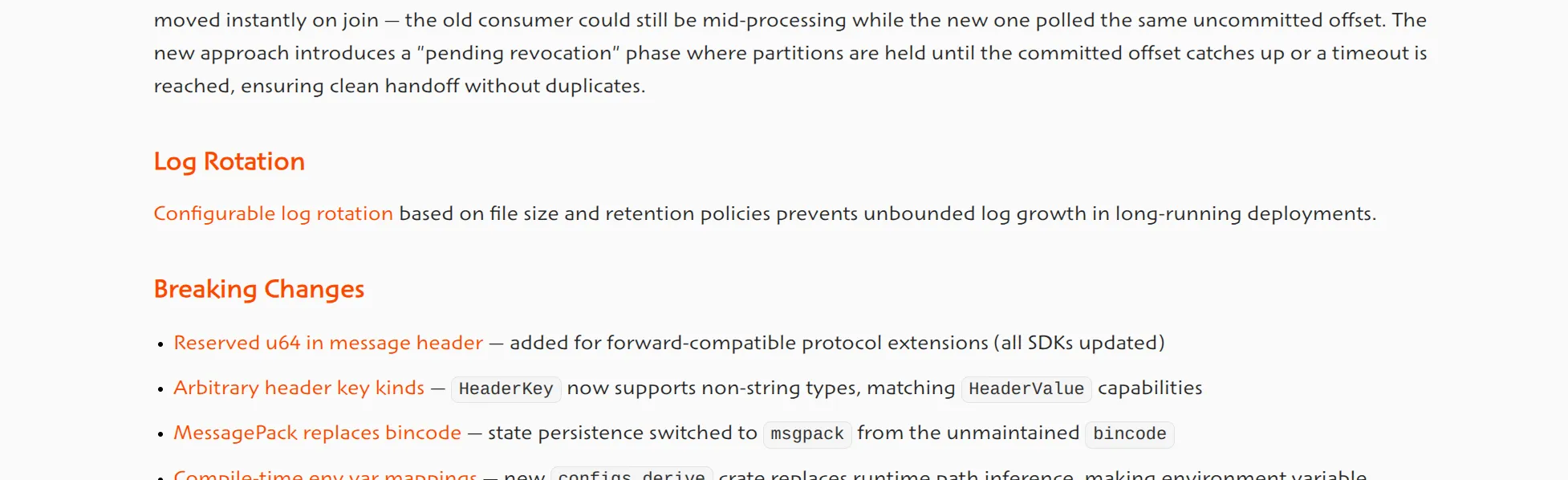
Iggy has upgraded to a TLP! [37,38]

References
-
The Apache Software Foundation, Apache Software Foundation Celebrates 25 Years, Mar. 25, 2024. [Accessed: Feb. 13, 2026]. [Online]. ↩
-
The Apache Software Foundation, Valuating Code at The Apache Software Foundation, DinoSource, 2022. [Accessed: Feb. 13, 2026]. [Online]. ↩
-
J. Gardner, Why Java Sucks, Jul. 18, 2017. [Accessed: Feb. 14, 2026]. [Online]. ↩
-
While I have created multiple commits locally, while the remote branch has updated some of these commits via a
squash merge, I would create a new branch and thencherry-pickthe desired commits one by one … Obviously,rebase --ontois fine. To use a trendy meme from the Chinese internet these days, it’s “Jiahao” exactly. ↩ -
America’s Cyber Defense Agency, Apache Log4j Vulnerability Guidance, ED 22-02, Apr. 08, 2022. [Accessed: Feb. 13, 2026]. [Online]. ↩
-
The Apache Software Foundation, Apache Log4j, Dec. 9, 2021. [Online]. (Log4Shell, CVE-2021-44228: Remote Code Execution (RCE) vulnerability, CVSSv3 10.0/10.0 severity) ↩
-
CrowdStrike, Remote Code Execution (RCE), [Online]. ↩
-
At my worst during this period, I even forgot the name of the PCIe interface. I didn’t know how to use Tmux either. I truly admire some middle school students who can code proficiently and contribute actively to various projects something I couldn’t do as a high school student. It was not until late 2023 to early 2025 that I gradually got back on track with Ubuntu. ↩
-
The Apache Software Foundation, The Apache Community Contributor and Committer Ladder , n.d. [Accessed: Oct. 10, 2026]. [Online]. ↩
-
The Cargo Team, The Cargo Book: Workspaces , The Rust Project, n.d. [Accessed: Oct. 10, 2026]. [Online]. ↩
-
The Rust Clippy Team, rust-clippy: A collection of lints to catch common mistakes and improve your Rust code , GitHub, n.d. [Accessed: Oct. 10, 2026]. [Online]. ↩
-
The Iggy Docs, Apache Iggy Documentation, n.d. [Accessed: Feb. 22, 2026]. [Online]. ↩
-
Initially, I aimed to avoid division by zero errors by outright blocking any operation that set the value to zero. Later, I noticed that
IggyByteSizeactually defines a specific meaning for the zero value, so I revised the logic to treat it as “unlimited” to align with the behavior stated in comments throughout the rest of the codebase. ↩ -
A. Kotsiolis, Simultaneous Multithreading: Driving Performance and Efficiency on AMD EPYC CPUs, AMD Official Blog, Mar. 3, 2025. [Accessed: Feb. 14, 2026]. [Online]. ↩
-
M. Kerrisk, mmap(2) - Linux manual page , Linux man-pages project, n.d. [Accessed: Oct. 10, 2026]. [Online]. (ENOMEM: the mapping would exceed the kernel’s overcommit limits.) ↩
-
Rust Team, The Rust Standard Library (std), Commit 01f6ddf75, Feb. 11, 2026. [Accessed: Feb. 14, 2026]. [Online]. ↩
-
J. L. Hennessy & D. A. Patterson, Computer Architecture: A Quantitative Approach (6th Edition), Elsevier, 2017. [Accessed: Feb. 14, 2026]. [Online]. ↩
-
The Apache Iggy PMC, Apache Iggy - Hyper-Efficient Message Streaming , Apache Software Foundation, n.d. [Accessed: Oct. 10, 2026]. [Online]. (“Each CPU core runs its own shard, pinned and NUMA-aware”; transports: QUIC, TCP, WebSocket, HTTP.) ↩
-
Wikipedia Contributors, Non-uniform memory access, Wikipedia, The Free Encyclopedia, 2026. [Accessed: Feb. 14, 2026]. [Online]. ↩
-
@linux, What is NUMA, and why do we need to understand NUMA?, Zhihu, Linux Server Development Column, Jul. 14, 2023. [Accessed: Feb. 14, 2026]. [Online]. ↩
-
The kernel development community, Overcommit Accounting , The Linux Kernel Documentation, n.d. [Accessed: Oct. 10, 2026]. [Online]. (Heuristic mode
0refuses “obvious overcommits” without a hard limit - the mode Iggy’s startup ran under.) ↩ -
Crate
hwloc: Rust Bindings for the Hwloc library. Thehwloclibrary is arustbinding to thehwlocC library, which provides a portable abstraction of the hierarchical topology of modern architectures, including NUMA memory nodes, sockets, shared caches, cores and simultaneous multithreading. ↩ -
hwlocality Developers, hwlocality: Rust binding for hwloc, [Online]. (Designed for hardware topology detection, NUMA support, and thread binding optimization; secure, easy to use & actively maintained). [Accessed: Feb. 14, 2026]. ↩
-
The Nixpkgs Contributors, Nixpkgs Manual - Multiple-output packages , n.d. [Accessed: Oct. 10, 2026]. [Online]. (The
devoutput splits headers and.pcfiles away from the default output.) ↩ -
CGPM, SI, Conférence Générale des Poids et Measures. [Online]. [Accessed: Feb. 14, 2026]. ↩
-
I.E.C., IEC 60027, International Electrotechnical Commission. [Online]. [Accessed: Feb. 14, 2026]. ↩
-
Wikimedia Foundation, Inc. & I.E.C., Wikipedia, Nov. 2023. [Accessed: Feb. 14, 2026]. ↩
-
J. Blandy & J. Orendorff & L. F. S. Tindall, Programming Rust 2nd Edition: Fast, Safe Systems Development, Sebastopol, CA: O’Reilly Media Inc., 2021. [Accessed: Feb. 14, 2026]. [Online]. ↩
-
T. Preston-Werner, et al., Conventional Commits , n.d. [Accessed: Oct. 10, 2026]. [Online]. ↩
-
GitHub Inc, GitHub Actions billing, Docs, Jan. 13, 2026. [Accessed: Feb. 14, 2026]. [Online]. ↩
-
The Apache Software Foundation, Our Sponsors, Apache Software Foundation Website, 2025. [Accessed: Feb. 14, 2026]. [Online]. (Sponsors, community, projects, and brand information). ↩
-
The Apache Software Foundation, Our Sponsorship Program, Apache Software Foundation Website, 2025. [Accessed: Feb. 14, 2026]. [Online]. (Sponsors, community, projects, and brand information). ↩
-
Act, Runners, Act User Guide, 2026. [Accessed: Feb. 14, 2026]. [Online]. ↩
-
J. Petazzo, Using Docker-in-Docker for your CI or testing environment? Think twice , Sep. 3, 2015 (upd. Jul. 2020). [Accessed: Oct. 10, 2026]. [Online]. (LSM profile conflicts, storage-driver nesting, and the socket-sharing alternative.) ↩
-
The Quickwit Contributors, Quickwit: Search engine for logs and traces , GitHub, n.d. [Accessed: Oct. 10, 2026]. [Online]. (An official sink target of Apache Iggy connectors, per iggy.apache.org.) ↩
-
@Jysve, Code 3858794990 Comments, GitHub, Apache Iggy Pull Request #2452, Feb. 6, 2026. [Accessed: Feb. 6, 2025]. [Online]. ↩
-
The Apache Software Foundation, The ASF Announces Apache Iggy as a Top-Level Project , ASF News, 2026. [Accessed: Oct. 10, 2026]. [Online]. See also the project page: https://projects.apache.org/project.html?iggy ↩
-
The Apache Iggy, Apache Iggy™ Graduates to a Top-Level Project, Piotr Gankiewicz, Kranti Parisa, 2026. [Accessed: Oct. 10, 2026]. [Online]. ↩

Continue reading
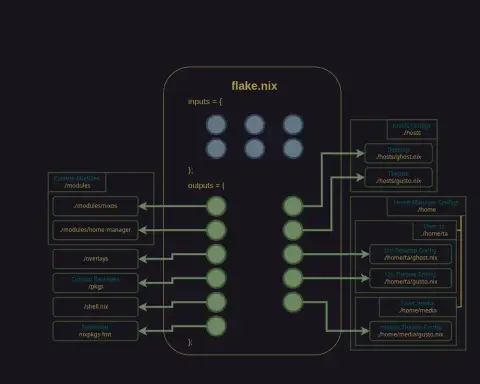
NixCN Conference Shanghai
This is a casual note, documenting my personal experience attending the inaugural NixCN Conference held in Shanghai, China, in August 2025, hosted by Prince213. However, I no longer use Nix, just leaving this here as a memento.


Markdown Navigation
Complete guide covering all features and Markdown support in this blog template.