NixCN Conference Shanghai
This is a casual note, documenting my personal experience attending the inaugural NixCN Conference held in Shanghai, China, in August 2025, hosted by Prince213. However, I no longer use Nix, just leaving this here as a memento.
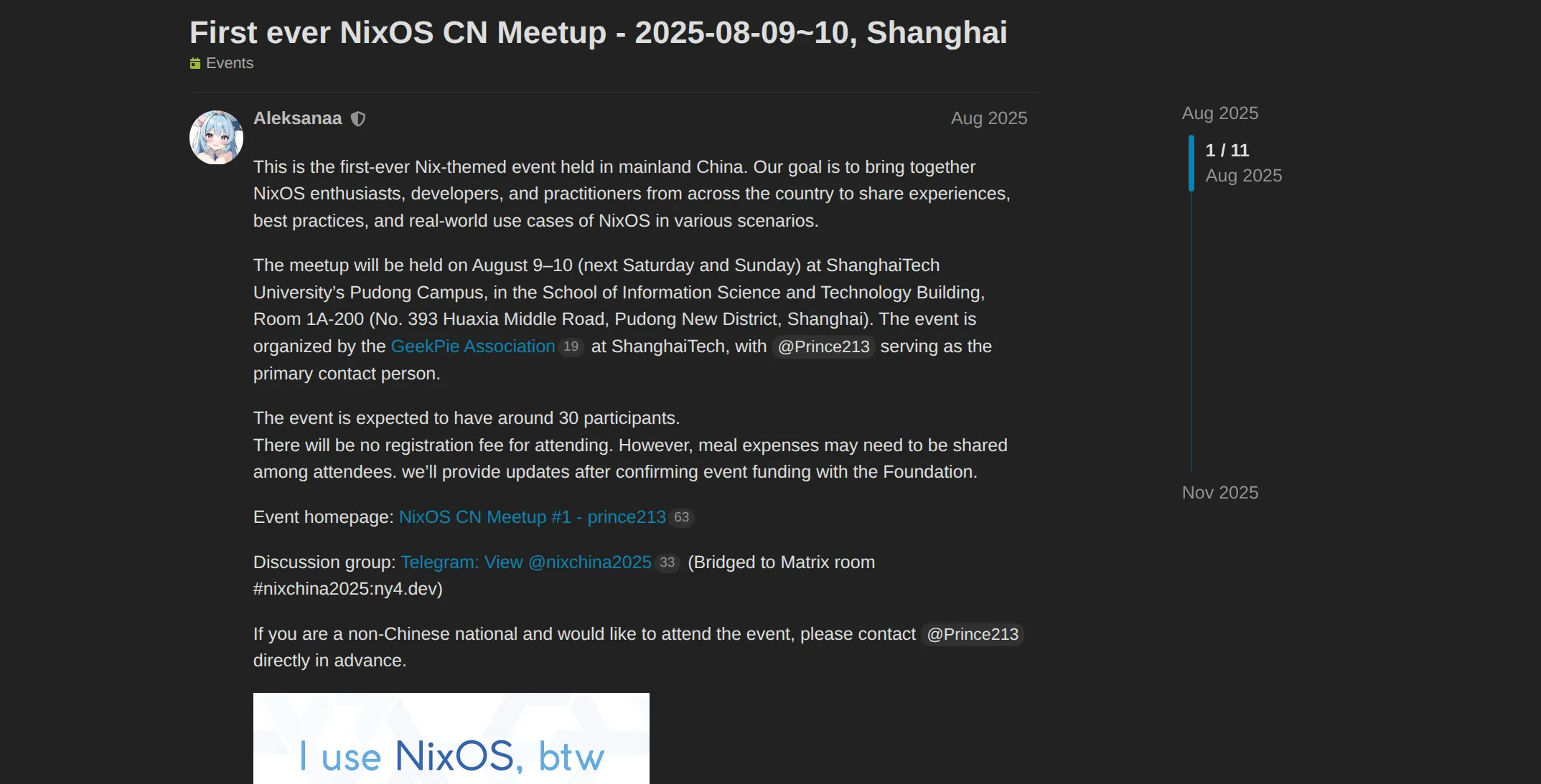
GMT+8 This event took place
on August 9th, 10th in Shanghai, China,
, hosted by @prince213, was the first conference in China
dedicated to Nix. Funding support provided by the NixOS Foundation.
For live stream records,
You can find @NixChina on the YouTube.
Links: NixCN Conference #1
/
NixCN Conference #2.

A note before we start: this piece was written in August 2025, days after I came home from China’s first Nix conference. I was a NixOS user then, with a workstation, a flake, and a package PR to my name. As of this year, I’ve moved on to F44. I’m leaving the article up anyway, lightly annotated, as a memento of the summer when I was all in.
What follows is the record of those two days, plus what I still think of Nix. It is also, I should warn you, the story of a socially anxious high schooler who spoke fewer than ten sentences in forty-eight hours.
As someone with severe social anxiety, I’ve always preferred expressing myself online. I dare not say a single word to people I’m not close to, and most of the time I didn’t even know what I was afraid of. Watching everyone chat freely made me want to join in too. I just couldn’t bring myself to speak. It is, too, really, too hard.
First Met
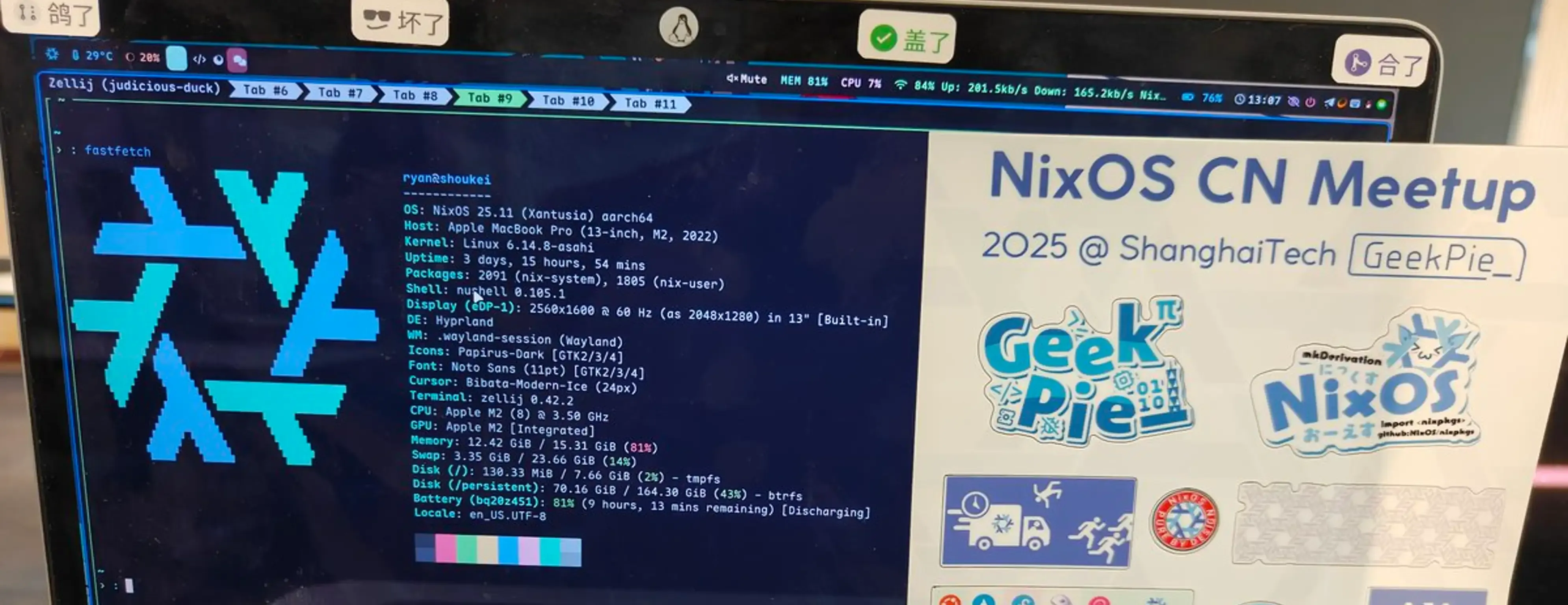
I found this screenshot from June 2024 in my photo album. I probably first learned about Nix around then, though it wasn’t until February 2025 that I actually started using NixOS. In early August, I saw the promotion for the Conference and joined their channel, but I froze the moment I saw the sign-up form. It’s, uh, scary.
Should I go or not? I couldn’t figure out why I hesitated.
- If I don’t speak up now, eventually, I’ll have to.
- If I can’t learn to interact now, every interaction will fail the same way in the future.
- Or, was it because I lacked confidence in my looks?

Well, I don’t care about my appearance. Nobody gets to decide it anyway. Just keep it tidy, and that’s that. I have to show my face to people sooner or later; can anyone hide forever? High school doesn’t leave me much time to gain social experience. So, after hesitating for a long time, I decided: just go for it. After all, I’m still a student - it’s okay to embarrass myself a little. I might as well get all the awkward moments of my future out of the way in advance, and, it even counts as a gain(?).
Eventually I decided. This was once revealed to me in a dream :)

I told my parents about it, and to my surprise, they agreed right away, and were unusually excited about it. Maybe it’s because I’m not like other high school students who stay home all day? I’m not sure. Few of us play games or scroll through short videos at home; we’re just a group of students who balance study and activities. In recent years, the local government leveled several hills and built Lishui Airport
- even our mountainous corner of the province has flights now. It was the perfect chance to take a plane for the first time.
Some people might laugh at what I’m about to put in this box. I’d understand, but I’m not going to lie, and I’m not afraid of being laughed at. These are all things I had never done before - that was the whole point. Looking back now, this trip handed me a pile of firsts:
- Flying, on an
Airbus A3201, flightMU6986; - Leaving Zhejiang Province2 (think of it as China’s California, sort of);
- Riding a high-speed train, and then a subway;
- Attending a tech conference entirely on my own;
- And many, many more …
When I arrived in Shanghai, I was struck by how huge and crowded the city was. The crowds weren’t a problem, but the prices, though, were shockingly high.
Off We Go!
Take the Plane
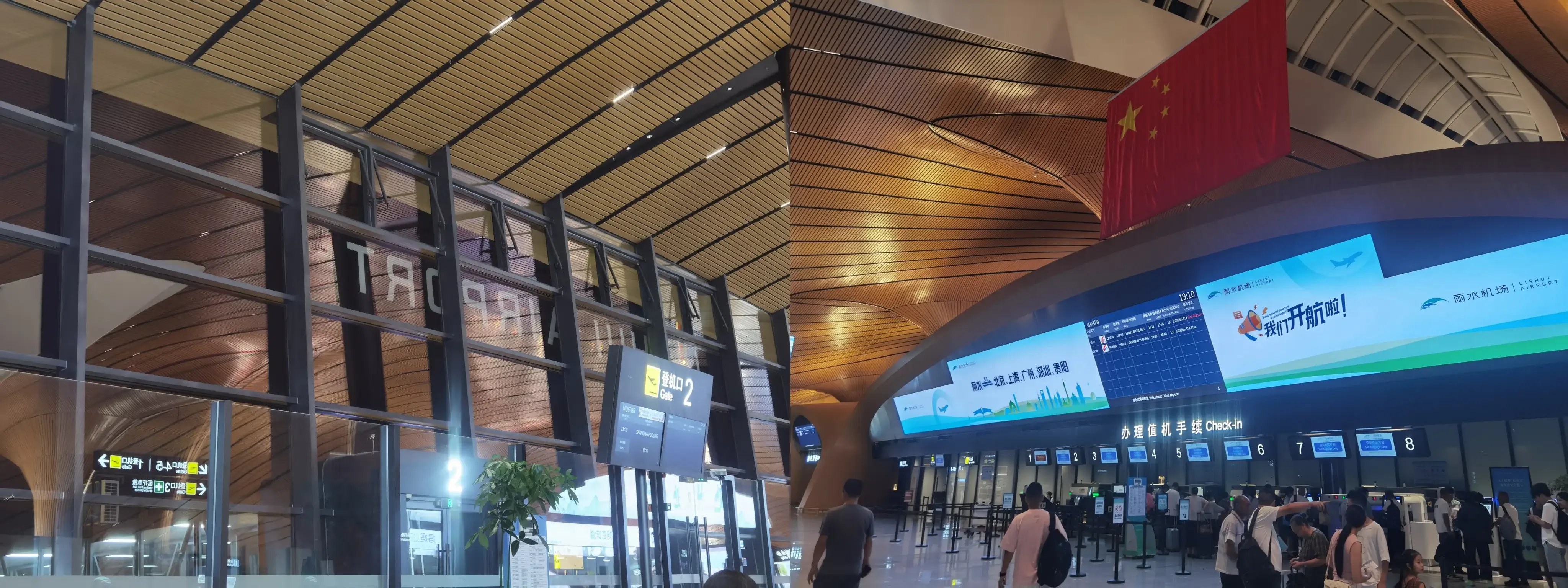

Too bad it was a night flight. For a first-time flyer, the view was - well, there was no view. There was no gamma can be set like what could we do in many games. After landing, actually, yes, I used a COMPASS to figure out which subway line to take Just about passable, for the record. Also perfect blackmail material, I’m sure.
Reach the Venue

We had access to STU, but it was time restricted. Since I arrived a few minutes early, I actually couldn’t get in on time. Luckily, @Prince213 guided me in, I snuck into the campus through a small door in the parking lot, lol.

Once inside, I saw large posters on the walls, so it was easy to find the venue.
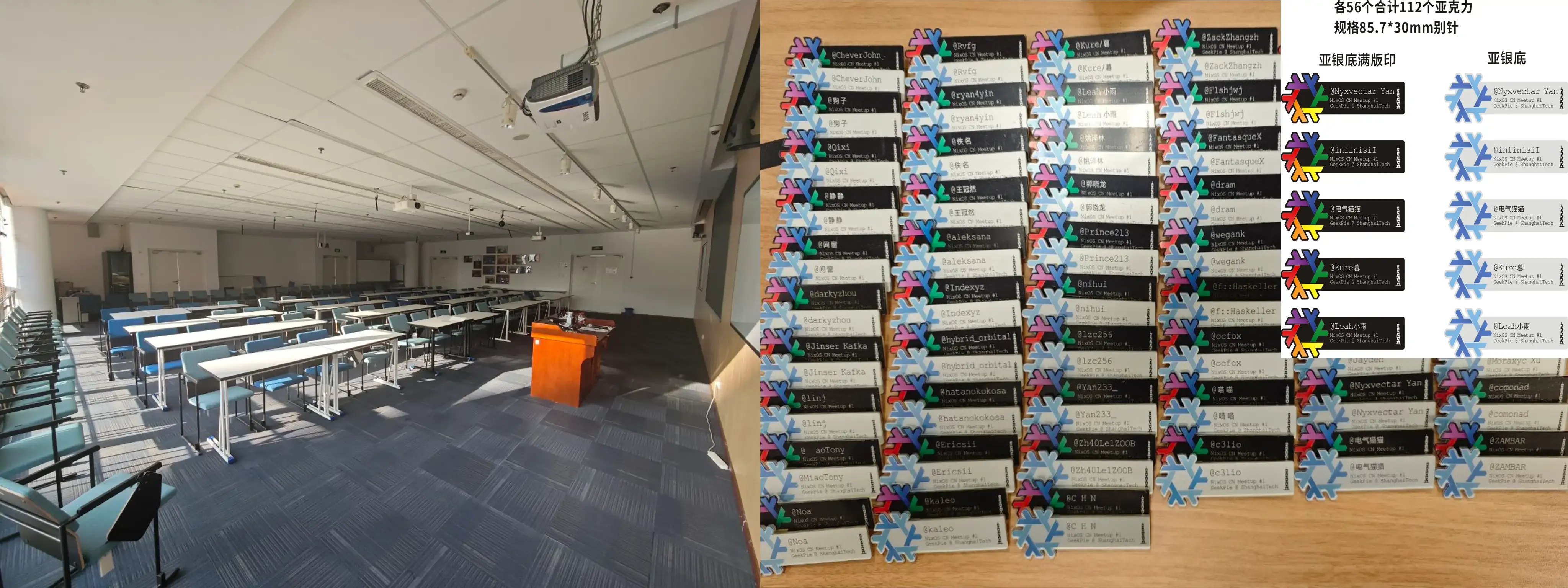
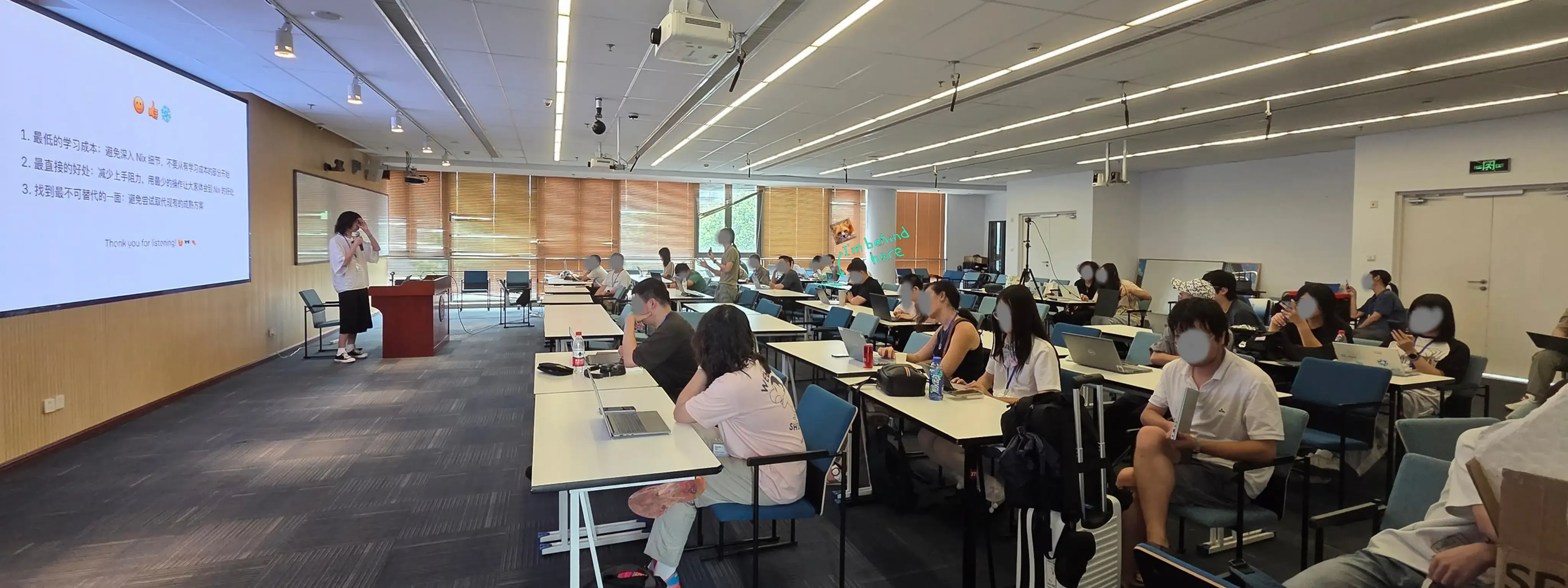
The volunteers had been there since early morning, setting up. Since
this was the first conference of its kind for Nix in China,
attendance was, objectively speaking, modest, around sixty people,
judging by the name tags. It was still more than enough to scare me
half to death. Well, I was here now; I might as well get something out
of it, and I’d better not complain again.

Some of the machines on display were quite special. For instance, there
was a Loongson3
3A6000 running NixOS, even playing Minecraft, which I
hadn’t expected at all. And yes, in the middle of this Linux
conference, I had brought a Windows4 laptop. Uh… maybe if I just
kept SSHing into my workstation over Tailscale, nobody would notice.
Mm… I hope. (Well, very soon I was unmasked. Someone
just said “There’s an undercover agent among us!” But to my surprise
that more than three Windows laptops were found out. lol)
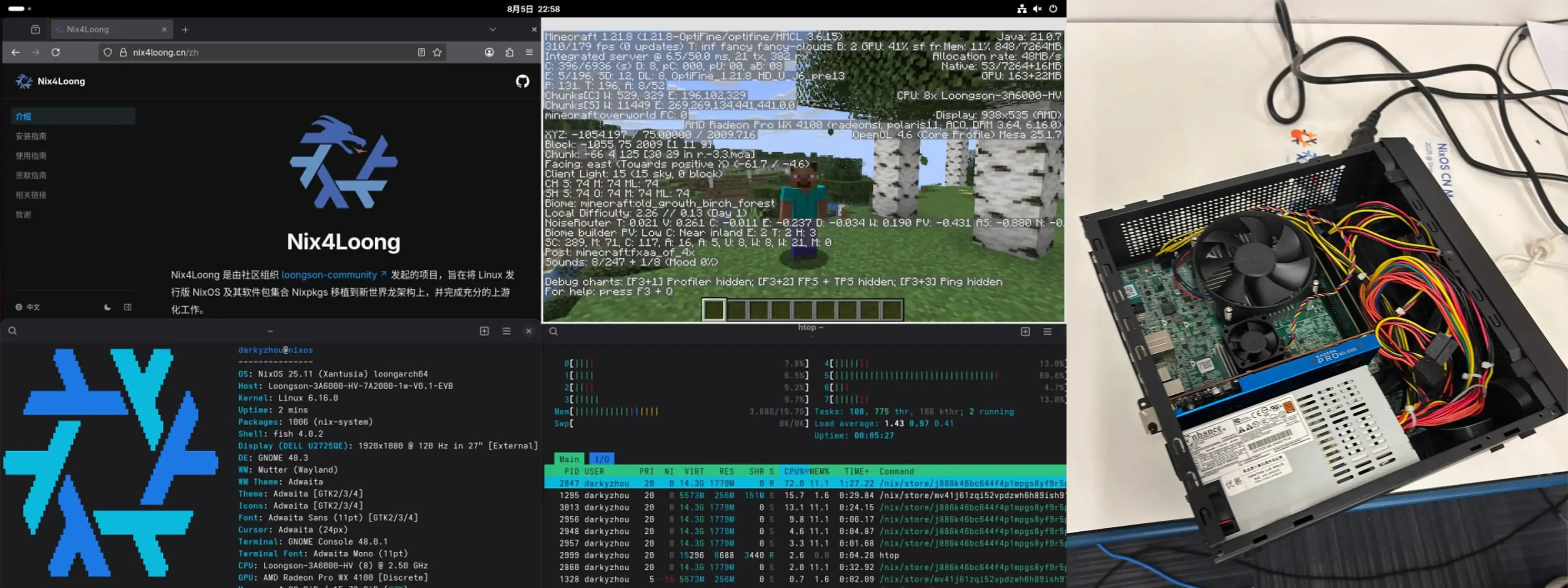
If a homegrown Loongson can run NixOS smoothly, compatibility
clearly isn’t the problem. Stability, on my end, was: my NixOS box -
an R9 9950X with DDR5-7200 (ECC on) - kept throwing a steady
stream of Corrected Error reports from the L1 cache. I tried many
things to fix it; nothing worked.
I couldn’t pin it on the hardware either, because, here’s the
funny part - the instability only ever showed up on NixOS.
Perfectly reproducible, bro.
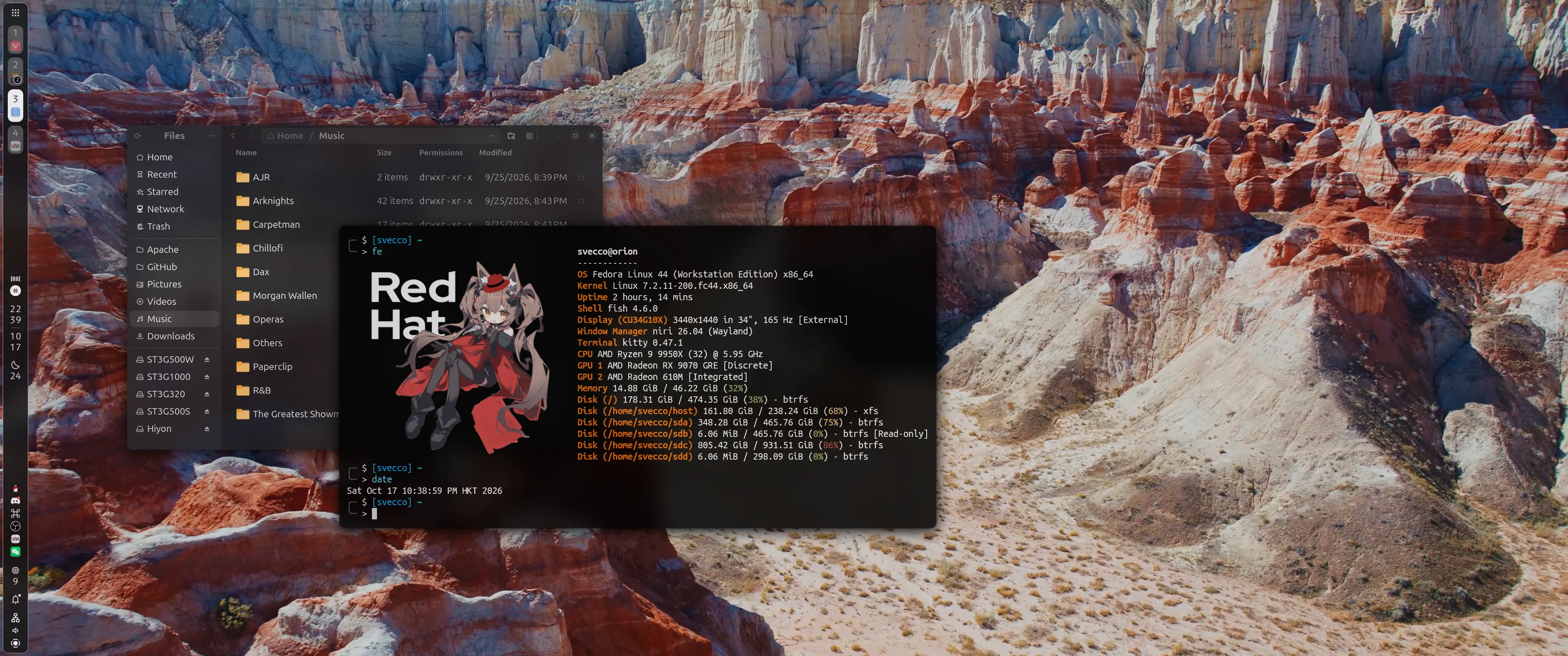
2026: this machine has since been rebuilt on Fedora.
Now it works fine.
Nix
Two days of talks, a demo table full of unusual hardware, and a lot of thinking on the flight home. The full agenda lives here ; what follows is what stuck, plus my thoughts on Nix , Nixpkgs and the community as of August 2025. Personal, opinionated, and, per the note at the top, written while I was still a nix user.
A functional package management ecosystem built for reproducible,
rollback-ready environments. “Reproducible” here is mechanical, not
vibes: every package lives in /nix/store/<hash>-<name>5, and that hash
covers every input - source, patches, compiler, build flags. Same
inputs, same store path, on any machine.
| Component | What it actually is |
|---|---|
Nix | The functional language and package manager underneath everything. Builds run in isolation; outputs are content-addressed by their inputs. |
Nixpkgs | The package collection built with Nix - packages and NixOS modules in one monorepo, often described as the largest of its kind. |
NixOS | A Linux distro where the whole system - packages, services, users, boot - is declared in Nix and built as one atomic generation. |
Routines and Arrangements
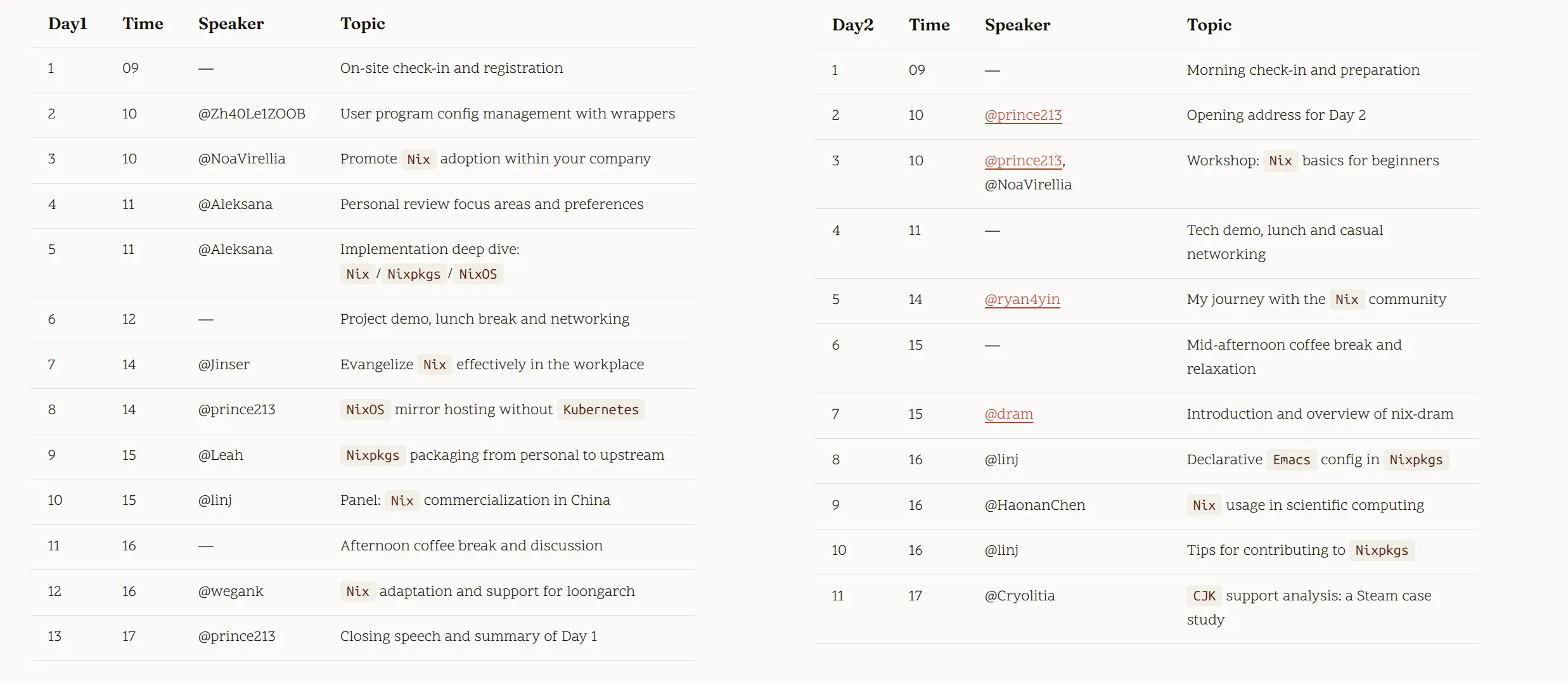
Time for a Meeting? Class
After that, I did what I do best: I listened. The talks themselves are all in the official agenda; what follows is my own take on Nix, Nixpkgs and the community. Personal, as of August 2025, when I was still a daily NixOS user.
If Gentoo Linux grew up alongside me, then K.I.S.S. will crash and burn with me, too.
That is not a metaphor. K.I.S.S. is a great way to build a system and a
terrible way to insure one. On Gentoo, /etc is years of handwriting,
world is archaeology, and package.use is a decision log no one can
reconstruct from memory. And when such a machine dies - by die I mean
die, won’t-boot, fsck-forever - the recovery procedure is a stage
tarball, a chroot, and whatever you can still recall. There is no
“previous generation” to select. For the philosophy, remember this:
What kept the system simple is exactly what leaves you with nothing to roll back to.
In the final moments, it looks like this:
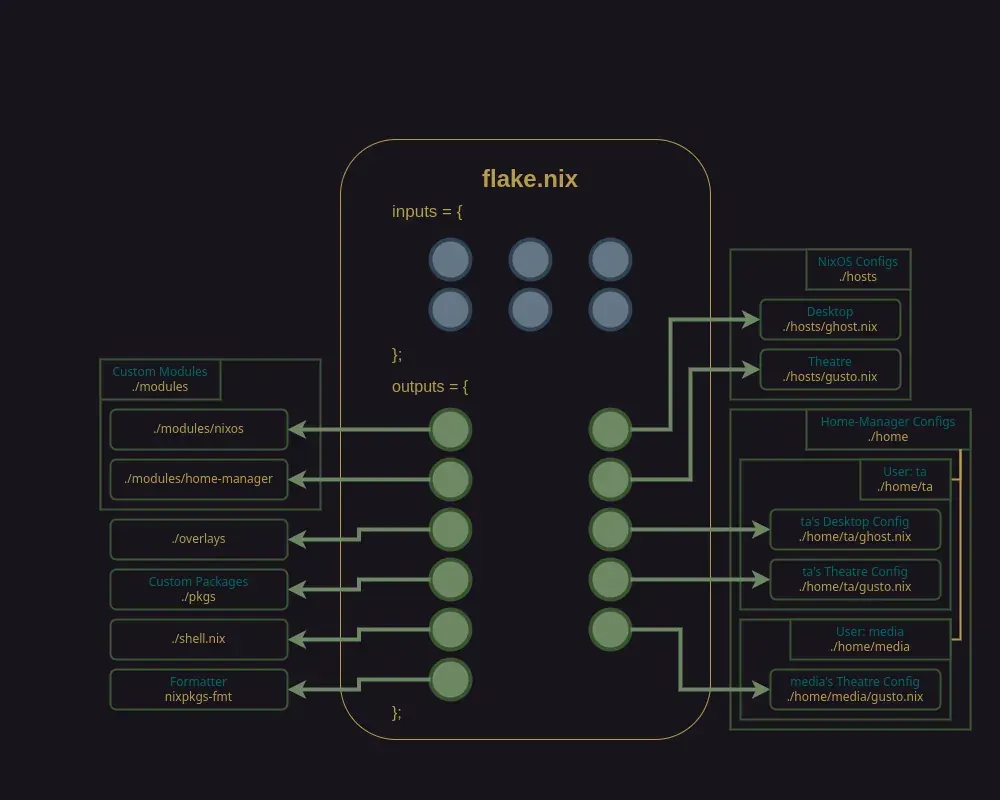
$ rm -rf / # LET'S GO. NO LOOKING BACK.And I really did run that command, on February 2nd, 2025:
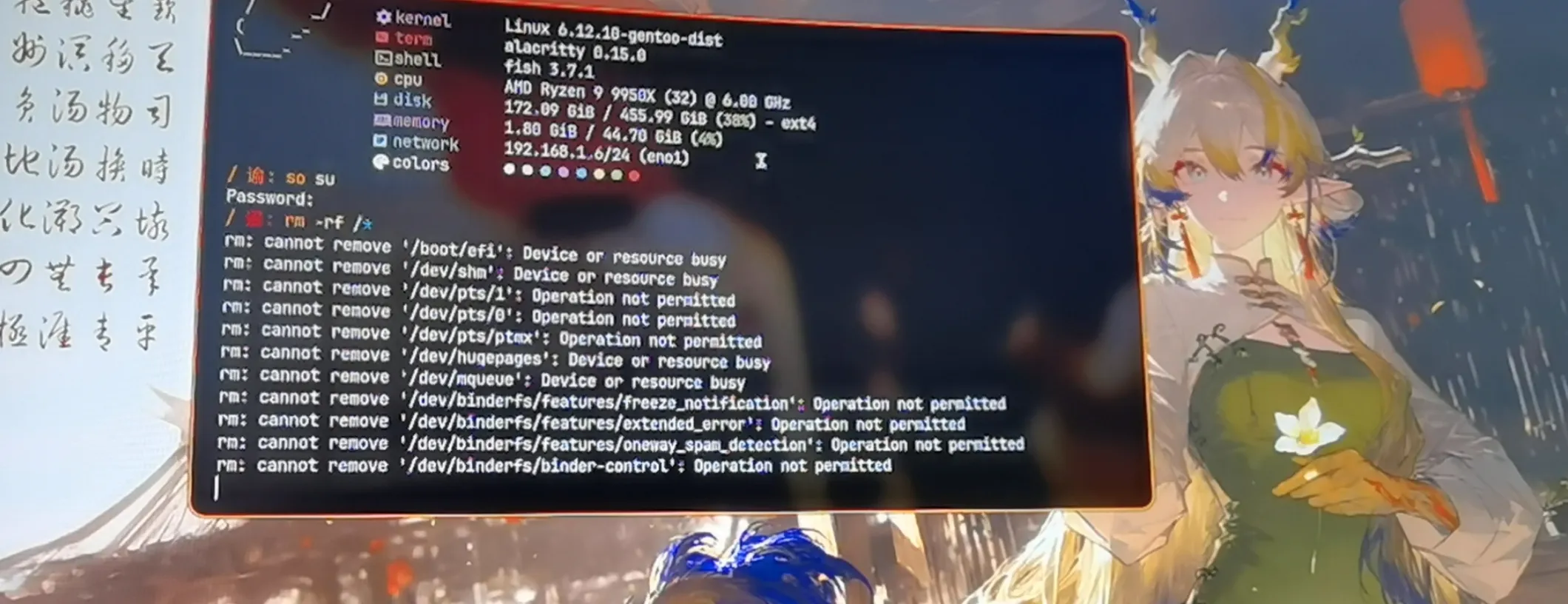
Which is why, sitting in the audience, I kept thinking: Nix is the system you would design specifically for Gentoo users - for people who already configure everything by hand, and have already watched it blow up. Every “obvious” Nix feature is an answer to a wound a tinkerer already has. How fitting.
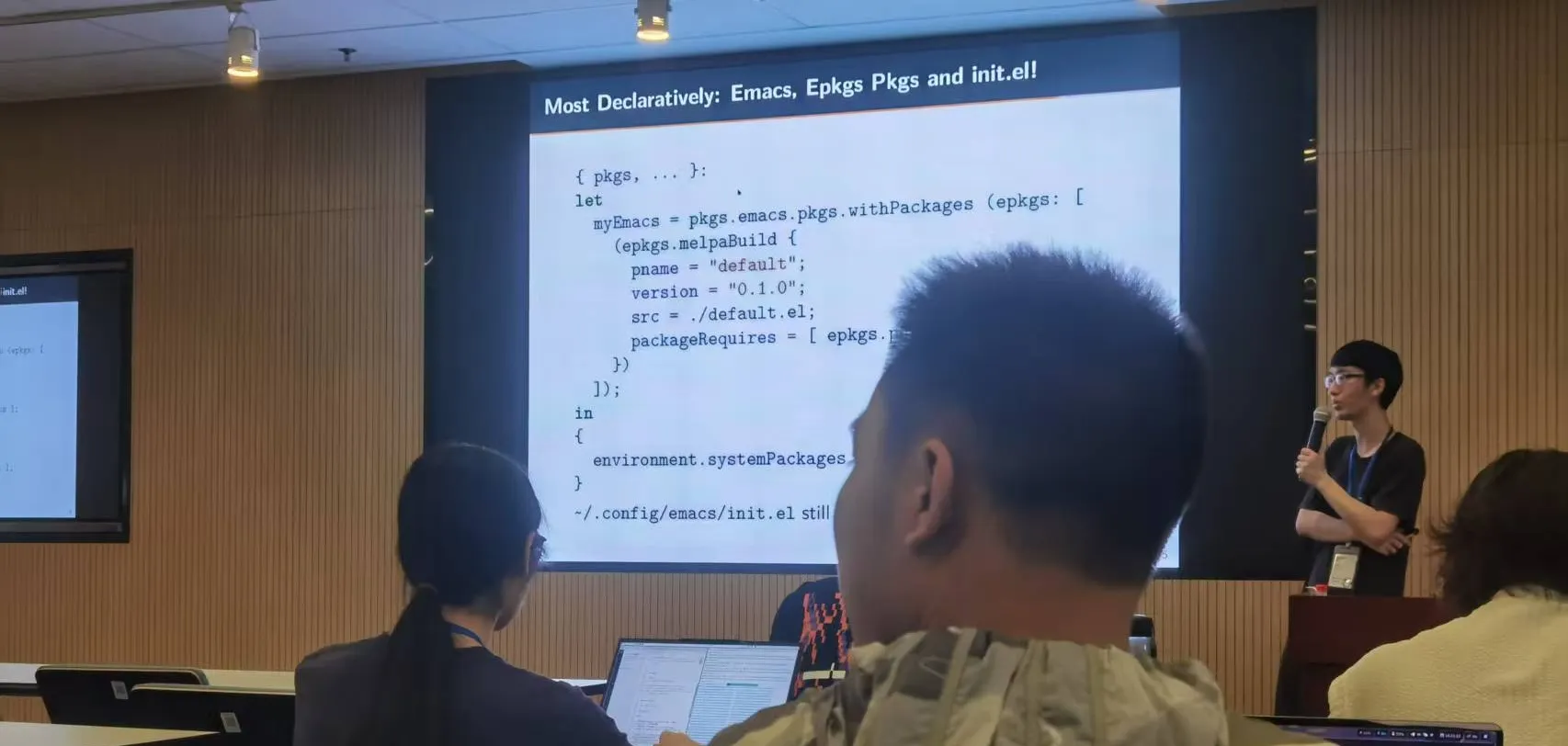
The core trick: each Nix declaration file corresponds to one
system environment. flake.lock pins every input to an exact commit;
the store addresses every build output by the hash of all its inputs;
nixos-rebuild6 records each result as a numbered generation. Nothing
is ever patched in place. System crashed? Pick the previous entry in
the boot menu. It is still
there, byte for byte. Broke the config? nixos-rebuild switch --rollback. New computer? One command:
doas nixos-rebuild switch --flake /path/to/your/flake#your-hostnameJust experimenting? nixos-rebuild test builds and activates the new
generation without adding a boot entry: try things, then decide.
And because one flake describes every machine you own, deployment is
one flag away:
nixos-rebuild switch --flake .#host --target-host root@hostPushes that machine’s configuration over SSH. Syncing environments across computers stops being a workflow you maintain. It falls out of the design. For someone with more than one machine, like myself, that alone is the godsend.
Underneath it all is a fact longtime Unix users feel in their bones: a
traditional system is three separate kingdoms. The package manager
rules packages (e.g. apt, dnf, pacman), a pile of dotfiles rules the
system, and every language ships its own version manager for
its own runtime. Three sources of truth, three ways to drift apart. Nix
collapses all three into a single language: packages, services, and dev
shells are all Nix expressions, evaluated together into one generation.
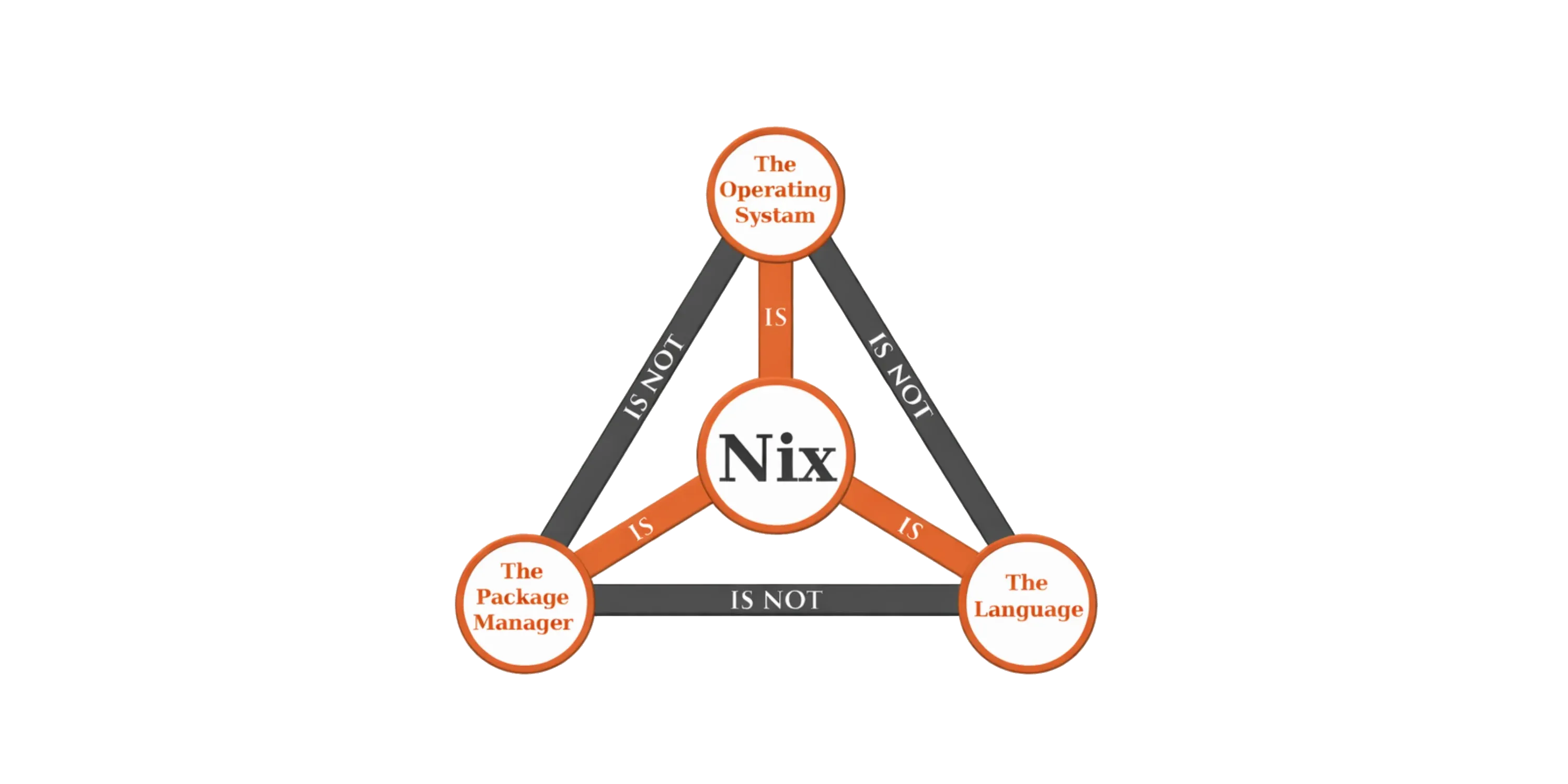
That combination makes Nix a great fit for scientific computing.
Haonan Chen is one of the attendees who has
dabbled in this field. I find him to be a genuinely fascinating
character. What’s more, it also suits tinkerers,
especially for people into ricing who are still
distro hopping. No offense intended. I used to be one of them.
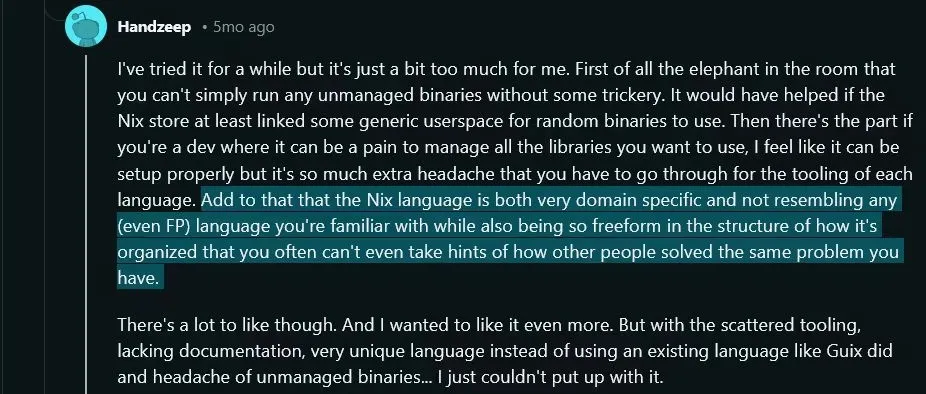
That said, it doesn’t suit me all that well. First, there’s the
stability issue I mentioned earlier. Second, Nix overshoots my
actual needs: what I do, a workstation plus a handful of containerized
services, is fully covered by Kubernetes and Podman. Run the code
on the server side, done.
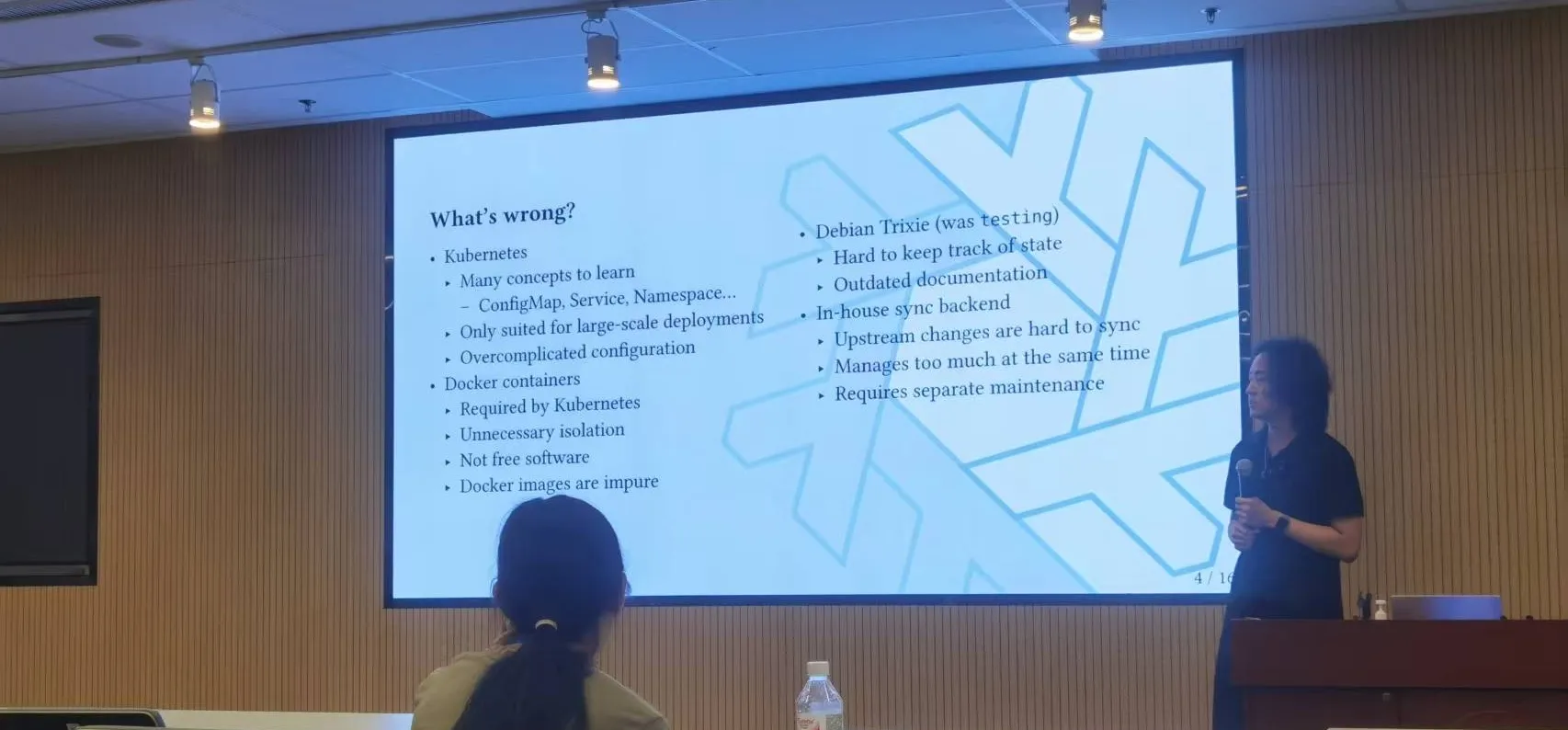
Sure, Nix has plenty of advantages over
Kubernetes at other layers, and plenty of people legitimately prefer
it, starting with the organizer,
@prince213 , whose talk was about
running NixOS mirrors without Kubernetes. Same question, opposite answers.
And then there are the special cases, like
@ryan4yin, author of
The Nix & Flakes Book.
If you’re getting started, that book is the unofficial,
beginner-friendly introduction I’d hand you first. That’s the tool.
The community around it is another story.

The Community
The community behind a tool says as much about it as the tool itself.
Nix has no corporate owner; its contributors come from all over the
world, and they review each other through
PRs on GitHub. That has real
consequences, both good and bad.
Start with the scale problem, because everything else follows from it. Nixpkgs is among the largest monorepos in existence: more than 400,000 pull requests over its lifetime7. At that scale, review bandwidth is the permanently scarce resource: it is simply hard to get any PR merged, for everyone. Even though there are far more active maintainers now than when I was running Gentoo, it’s still common for PRs to sit unreviewed for months on end. Mine took months, and I have no complaints. That’s just the arithmetic of volunteer review.
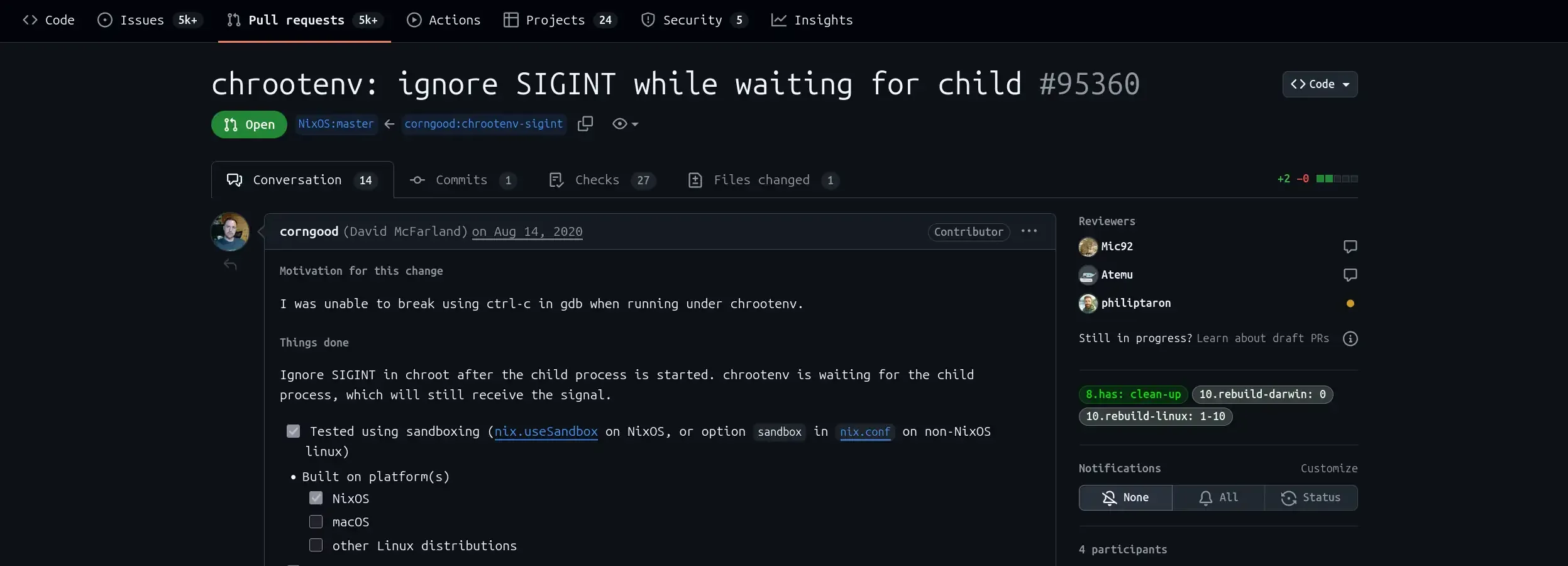
There are mitigations, with a catch. Nixpkgs has a merge bot that lets
maintainers merge their own PRs once checks pass, but using the bot
requires being a maintainer first. For the record, the constraints
are narrower than “maintainer” alone
suggests: the bot only works for packages under pkgs/by-name/, only
accepts PRs whose author already has write access, and only targets
master, staging, and staging-next. A maintainer triggers it by
commenting @NixOS/nixpkgs-merge-bot merge, and CI plus OfBorg checks
must pass first.8 So even if fine print aside:
The gate itself is also the gate.
Everyone else queues at the same window as before, so the bot shortens the line only for those who already hold the keys. If you’re not one yet, there’s no shortcut: you actively reach out to people. I hope the community finds better solutions down the line.
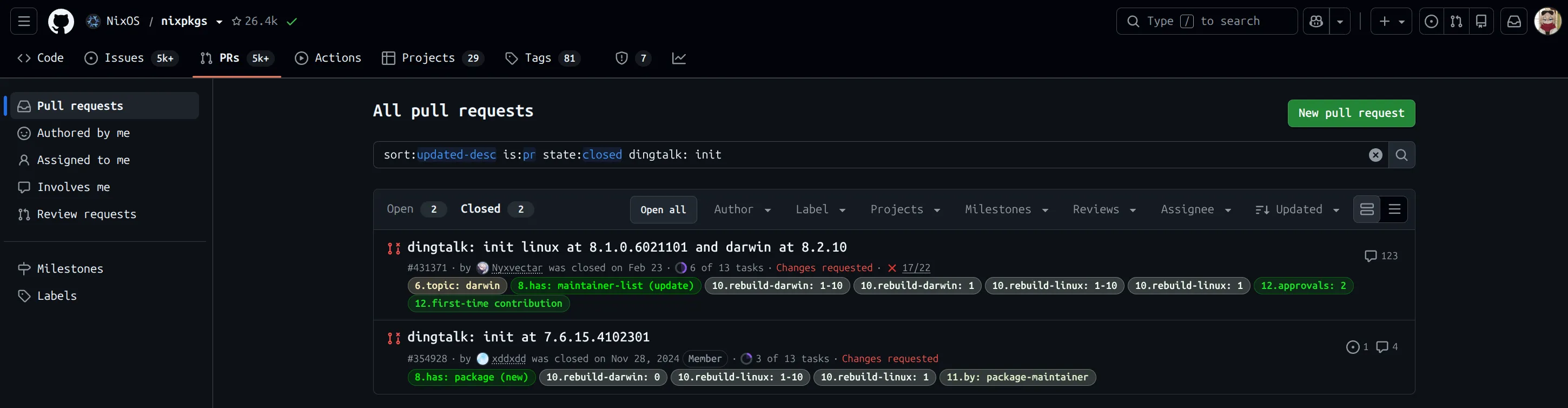
Scale isn’t the only filter, though. A second one is regional asymmetry: contributors are global, but a reviewer who can’t read the upstream docs, changelogs, or issue tracker can only check that something builds, not that it behaves. Some poorly packaged versions with strong regional characteristics have therefore landed on main relatively quickly, although things have been improving lately.
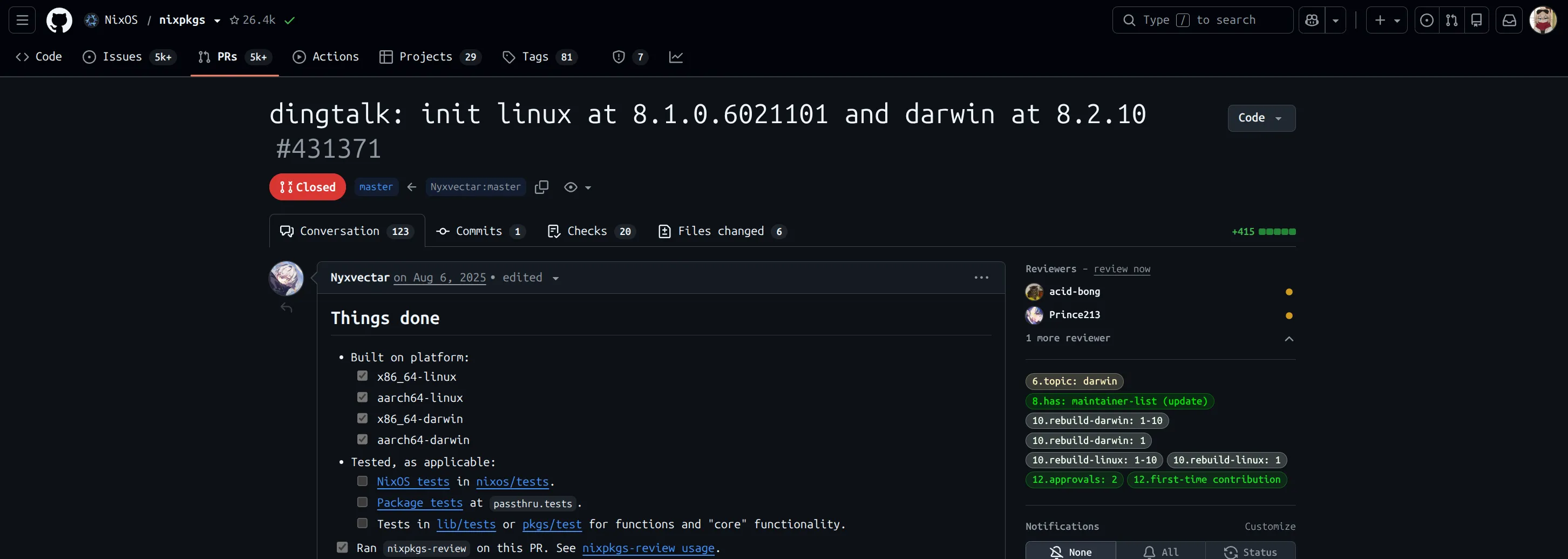
The third filter is the one no one in the pipeline can fix: the
upstream itself. For instance, the dingtalk package above has
various problems, large and small. They all live upstream.
DingTalk ships no changelogs, no versioned tarballs, nothing a packager
can pin. To report to Alibaba?
Since they’ve stuffed an LLM into their shopping app, you really shouldn’t expect
them to fix your bugs anymore! The outcome was either silence, or my personal
favorite, the affected feature being removed outright.
Wow, great job “fixing” the bug by deleting the feature 🫰🏻
meta = { description = "Enterprise-level communication platform developed by Alibaba"; homepage = "https://www.dingtalk.com"; license = lib.licenses.unfree;11 collapsed lines
platforms = [ "x86_64-linux" "aarch64-linux" "x86_64-darwin" "aarch64-darwin" ]; sourceProvenance = with lib.sourceTypes; [ binaryNativeCode ]; maintainers = with lib.maintainers; [ jysve prince213 ]; mainProgram = "dingtalk";};The telling line is sourceProvenance = [ binaryNativeCode ]: it
declares that the package ships upstream’s prebuilt binaries instead of
building from source. It is the honest flag for anything closed-source,
and one more thing a reviewer cannot lean on, because the artifact
they’d be reviewing is upstream’s, not the community’s.
These days it is extremely difficult to reach a human customer
service representative at Alibaba. Opening the support interface
leads to an unhelpful AI chatbot. These are problems I cannot
resolve on my own, and many other closed-source packages suffer
from the same issue, such as ToDesk.
But to tell the truth, none of this makes me pessimistic.
In a time when systems and distros
are thriving everywhere, Nix is a trend and
NixOS is “the BTW” now.9
My own verdict hasn’t moved, though. Nix solved problems I didn’t
have, and didn’t solve one I did, the instability I traced above.
Fedora’s boring is exactly what I need right now. I’d still recommend
NixOS to anyone whose pain is environment drift; I just stopped
counting myself in that group.
Interludes
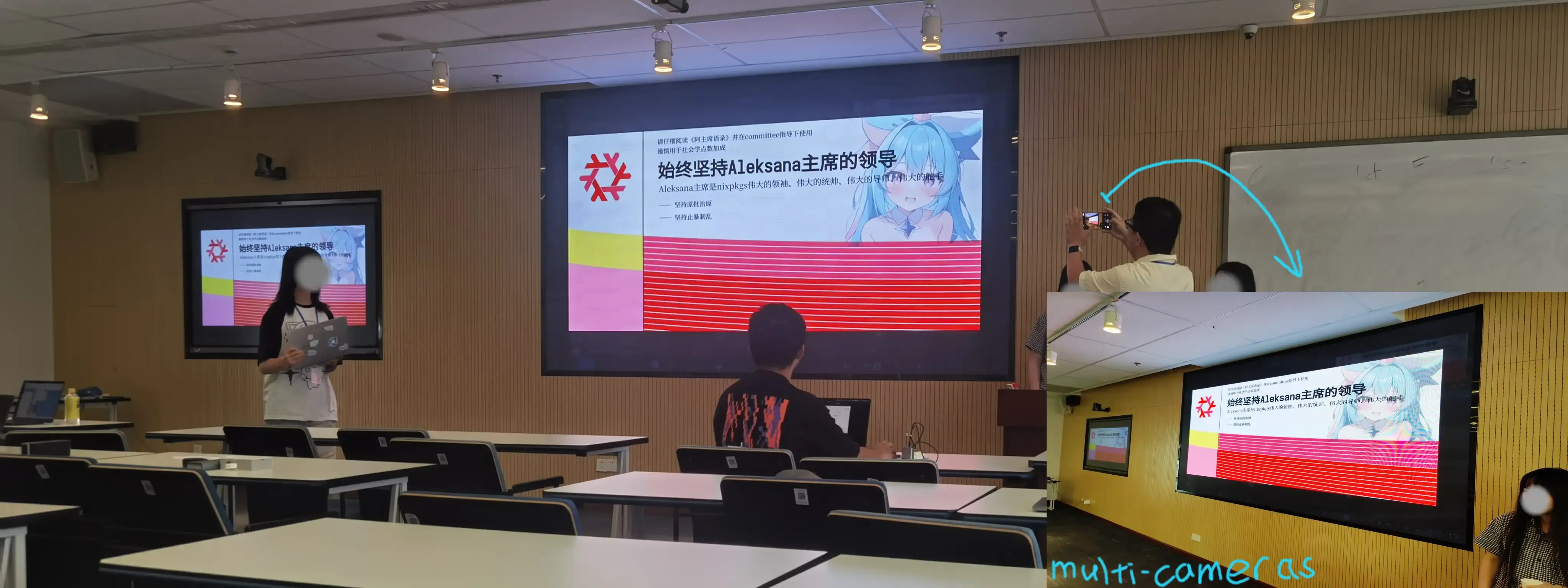
Unswervingly uphold the leadership of Chairman @Aleksana.
Yes, that is the actual register of the joke. The over-the-top formality is the point. And underneath the formality: @Aleksana is genuinely one of the key figures in the Nix community, a dedicated contributor, and someone I respect a great deal.
If you visit her personal homepage, you’ll find that the cards and tiles in the middle - even the text - are draggable. Just a heads-up: she’s usually busy.
She attended remotely. We still came away with a, em, memento:
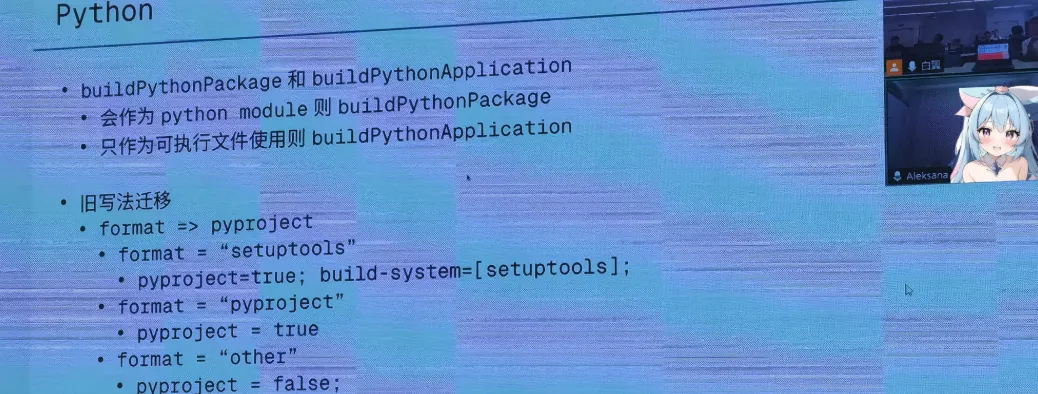

You can leave the Chinese internet, but the Chinese internet never leaves you.
The figure on the laptop is Cai Xukun, a Chinese celebrity whose basketball performance became one of the most enduring memes of the Chinese internet; _Xiao Hei Zi* is what his ironic fans call themselves. The machine, for those wondering, is a Lenovo Legion.
Some people like to push their glasses up with their middle finger. They may be right beside you - sitting quietly, minding their own business. Get too absorbed in a talk, and you may not gauge the pressure all that well.
Which is how, deeply absorbed in a talk, I pushed my glasses up with my middle finger while looking at the speaker on stage - and, unsurprisingly, the glasses broke. From the middle, btw. Good job. Pop!10
Time to Go Back
I took a few photos before I left. Opportunities like this don’t come easy for me.

Two days only. It felt like torture the whole time. I came here to push myself, to get over this fear, to talk to people. I failed. Barely a word out of my mouth the entire time. But even so. It really did broaden my horizons.
I know I need to step up. Next time. If there even is a next time *sigh.
Chores
Fedora
People Specially
 Aleksana@aleksanaa. The site with the draggable tiles.

 Haonan Chen@chn and many. A man not as cute as his avatar.
 Ryan Yin@ryan4yin. Long and hard the road, but walkers shall arrive.
 Sizhe Zhao@prince213. The vice president of the GeekPie Association.
Speechless.

References
-
You know, as an aerospace enthusiast and DCS player, I only took my first flight that day. ↩
-
Strictly speaking, when we visit relatives, geographical factors mean we technically cross the provincial border, just barely. But we’ve never done it with a plan. ↩
-
Loongson is one of China’s leading brands of homegrown general-purpose CPUs. It developed its own independent instruction set architecture,
LoongArch, and its processors power PCs, servers, and embedded systems. Details here. ↩ -
I don’t have my own laptop. So I borrowed my dad’s :) ↩
-
NixOS Foundation. Nix Package Manager Guide - “Store Paths”. [Online]. Available: https://nixos.org/manual/nix/stable/store/store-path (accessed 2025-08). ↩
-
NixOS Foundation. NixOS Manual - “Changing the Configuration”. [Online]. Available: https://nixos.org/manual/nixos/stable/#sec-changing-config (accessed 2025-08). ↩
-
Source: GitHub search for
is:prin the NixOS/nixpkgs repository, retrieved August 2025. The count includes open and closed PRs since 2012, and closed here includes merged - which is rather the point. ↩ -
NixOS. nixpkgs-merge-bot - “Allows package maintainers to merge in nixpkgs” (repository README). [Online]. Available: https://github.com/NixOS/nixpkgs-merge-bot (accessed 2025-08). See also Nixpkgs Contributing Guide: https://github.com/NixOS/nixpkgs/blob/master/CONTRIBUTING.md ↩
-
For the meme-literate: “I use Arch, btw.” ↩
-
Like the sound you’d hear in a chemistry laboratory, attracting everyone’s
attentionstare. ↩

Continue reading

Encounter Apache Iggy
Documenting my experience as a student contributing to Apache Iggy, an incubating high‑performance message‑streaming project under the Apache Software Foundation. It covers many obstacles overcoming, alongside pitfalls.

Markdown Navigation
Complete guide covering all features and Markdown support in this blog template.